Remember...

Ancestral energy lives in the stars above us, the stones beneath us. Their memory gathers in oceans, rivers and seas. It hums its silent wisdom within the body of every tree.

Showing posts with label magic. Show all posts

Wednesday, July 19, 2017

Altars to Alter Space in a Place

I make altars wherever I go. Sometimes when I use the word, people who know I am pagan quiet, not certain how I mean it. Merriam-Webster defines it as “a usually raised structure or place on which sacrifices are offered or incense is burned in worship —often used figuratively to describe a thing given great or undue precedence or value especially at the cost of something else.”

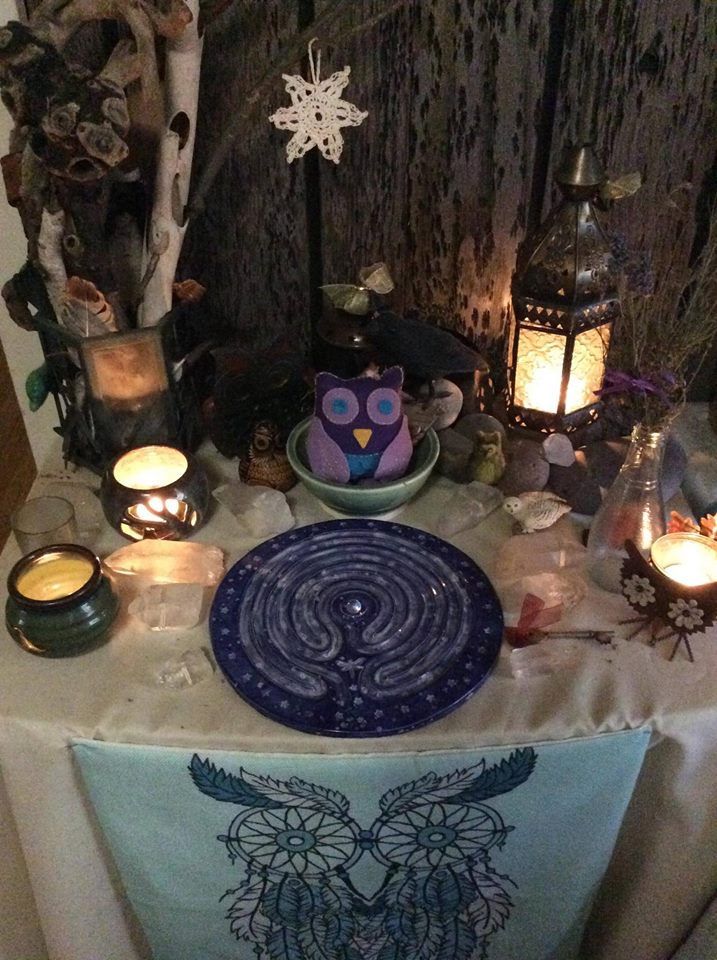
That's fairly accurate. I would define it as a space dedicated as sacred, dedicated with a specific spiritual purpose. I have many in my home and over the years they have been featured on my blog in photos. There are three in my office. The main one is my ancestor altar. There is a second one dedicated to Kuan Yin and Jizo that evolved during my work on finding peace within myself. The last one I call my Working altar. It changes with my spiritual progression but it is always sacred. I don't even set a cup on it for a moment. If you know me, that's saying something.


It is a large part of my dedication to hold what is sacred to me as sacred every day. The creation and tending of altars is integral to that work. They are placed through the house, in the kitchen and the living room. We often joke that if there was room in the bathroom we'd put one in there, but it's a true statement. Some of our altars are so old they look like purposeful artistic installations.

We make ones when we go to the woods. When we go camping. When we stay in hotel rooms. And when I visit my family.


Working Altars
Last year I was in a space of recovery still and I set up a small altar with a piece of fluorite I has used in the Burn ICU. As the week progressed and I pushed at the edges of what was physically possible for me, I added objects to it I found in the park and on the beach and it became a thing of beauty and peace to my heart.


Healing Altars
When I initially had my accident, we created altars in our home with items sent from our loved ones.


And then friends of family of different faiths and beliefs rallied together to send me thoughts and prayers. Each of them created something personal to them with my health and in mind. They were altars created while I was in a coma and my life was uncertain. With their permission, I share some of the photos, just a sampling of altars built around the country, connecting energetically in one purpose. Magic.

From Anne's home...

...and Dani's home...

...and Heather's home...

...and Irene's home...

...and Kaye's home...

...and Kim's home...

...and Michelle's heart...

...and Rahdne's home...

...and Tracy's home.


Altars in Nature
I spend a lot of time in nature. Not as much as I'd like to, but it's my happy place. It fills me with such joy that I feel drawn to make temporary altars in gratitude for the time and space I share with the land and it's other inhabitants. I use what's around- sticks and stones and leaves and ferns and flowers and feathers- and I let my heart guide the end result. There are some spaces we travel often enough that the altar has become more permanent. Enough so that those who visit the space feel the sacredness laid down.

Isn't that the best magic?


Wednesday, October 28, 2015

The Rite of Passage in Trick-or-Treating

When I think of Halloween, my mind drifts to cups of mulled cider, the crunch of fresh apples, bright orange jack o’ lanterns, crisp leaves underfoot and the smoky breath in the evening air that foretells the coming of winter. The holidays of my childhood evoke memories of monster movies and spider webs, pillowcases full of candy, bobbing for apples, spooky houses and things unknown.
And trick-or-treating.
Once a year we had permission to, and were encouraged to, dress in costumes while travelling door-to-door, collecting candy in our pillowcases. Looking back, I understand that Halloween was a chance for an insecure girl to wear another skin, someone else I might be. Our parents would ask us, “What do you want to be for Halloween?” and the universe would open before me. When I didn’t have an idea for a costume I would raid my parents’ closet and come out some version of hobo, hippie or gypsy. Halloween, dipping us into darkness, was ripe with possibility for those among the living.

Halloween has its origins in the Celtic festival of Samhain, pronounced sow-en, eventually coming to America with immigrants in the 18th and 19th centuries. Children went out into the night carrying lanterns lit with candles, called samhnag, made from turnips. The root vegetables were carved with frightening faces to scare away the spirits wandering the night. Children went from home to home, guised in supernatural costumes, where they were given offerings of food or coins. The gifts were meant to help the children ward off any spirits wishing to do harm on Samhain, the night when the dead walked again.
Some later customs refer to it as Souling, where children would offer prayers for the dead in return for a small cake. At houses where they were refused, they would batter the door with the butt ends of turnips. One of the earliest records of guising for Halloween comes from 1895 Scotland. A North American reference to it in a newspaper in Ontario in 1911, reports that children would go guising between six and seven on Halloween, spilling songs and rhymes and being rewarded for them with candies and nuts. Trick or Treating as we know it in America didn’t begin until the 1950s.

Our parents carried us door-to-door when we were children and later, when we could walk on our own, they would coax and encourage us to go up and ring the doorbell while they waited for us on the sidewalk after a whispered reminder of what we were meant to say. The walk to the porch was long to my short legs. The temperature in the air dropped in the space between my parent and the heat behind the unfamiliar door opening before me. After a hearty “Trick or treat!” and a piece of candy dropped in our pillowcase we would run back to our parent, back to safe, and on to the next home.
The first year that we went out trick-or-treating without chaperone- our own little gang of tricksters- was an early, and personal, rite of passage. Mom stayed home to mind the door and was busy making sheets of homemade pepperoni pizza so it would be hot and waiting when we came in out of the cold. We walked the neighborhood and then the same route we walked every morning to elementary school. Up one side of the street and home the other. It was familiar and known, but in the cloak of darkness it felt foreign. Landmarks stood in shadow and we needed new eyes to find our way.
We were being trusted to watch out for each other, to stay safe, to cross streets wisely and not to stray beyond the streets we knew, or the ones we were told we could travel. As children we didn’t realize how far the web of grown ups-who-knew-each-other spun and we were not hip to the fact that we were never in any true danger.  But that unknown is an essential element to the rites of passage that test our mettle and help us grow. The cold leaves crunched underfoot as we ran from porch light to porch light, pillow cases filling fast with candies my brother and sister and I would later sort through and trade (always setting aside some tootsie rolls for my dad).
There was one house that was always decorated fantastically for the trick-or-treaters. And then one year, the house was barren, the only decoration a scarecrow flopped onto the porch with a bowl of candy in its lap. A lot of houses that closed for the night would put the candy bowl out on the porch with a note. As we closed upon the porch, I felt a strange feeling in my belly and I stopped. That’s a person, I thought. I knew that when we got up there, the scarecrow was going to grab us.
We stood still, watching the scarecrow and debating whether or not it could be a real person. We dared someone to see what kind of candy was in the bowl so we could gauge whether or not it was worth it. The scarecrow didn’t move the entire time and was sitting at a strange angle. We approached in a group and as I reached into the bowl… the scarecrow grabbed my hand as we screamed and ran halfway back down the sidewalk. A familiar voice laughed, assuring us it was our neighbor. We stood our ground and made him show his face before we went back for the candy we had earned.

There was a thrill in being able to be brave without the need for a parent. On our own we had evaluated the threat, calculated a plan and supported each other in carrying it out, calling on the energies of our Other skins to aid us. On Halloween we stood in the shadow of no one. It was always light when we started our adventure and in the joy of running from porch to porch we would lose the subtle slip into darkness until we were cold and tired and our bags were heavy with loot. Often, home seemed far away. We would slip home and share stories of what we had seen on our travels.
The next morning’s walk to school, I was aware that the same-old route I had been taking every morning was different. It was bigger. The houses weren’t just landmarks anymore. They were also skins of homes with families and faces inside of them, containing other children who thought the world was no bigger than the size of their house. On that morning I understood the world was bigger than my house, my block, my route to school. There was more of it than I could comprehend.
As a child, on Halloween night I walked with demons and devils, witches, ghosts and ghouls borrowing human skin, along with superheroes and princesses. I dared to enter dark places and returned from them unharmed. In the turning of the world, I learned I could enter the darkness and return. Maybe not unscathed, but I could return and know the healing would come. Each year now, as I drop candy into the bags and baskets of little cows, superheroes, witches and pirates, I hope they will remember their fearlessness on this night. I hope they will remember how they learned to move from jack o’ lantern light to jack o’ lantern light as a way as a means to get through the darkness.

[Originally published October 26, 2011.]

Wednesday, June 3, 2015

Ancestor-Walking Beneath the Stars

Photo of the labyrinth I walked by Amy, 2015.
The best thing about a labyrinth is that it’s a physical meditation of your body in motion as you journey internally. You can walk the same labyrinth every day and feel like each day is a new journey. Sometimes I use the labyrinth as a means to petition my ancestors, and the seven-circuit labyrinth is my favorite.
I recently attended a candle-lit labyrinth on the beach, beneath a starry sky, organized by a woman I have had the great pleasure to study with and work with, Tracy Andryc, a Veriditas Certified Labyrinth Facilitator. I emerged from the woods after leading an Evening Devotional in the Ancestor Shrine and travelled across the sand, bringing my ancestors with me. I stepped into the labyrinth with a purpose.

As I put each foot in front of the other in the first circuit, I allowed myself to sink deeper into the earth. I sank down through the layer we trod on, through the layer the burrowing animals and insects live in, through the layer where the bones and ashes of our dead are buried. At this layer, I began to call to them.
In the second track I called to my grandparents, to the four who have crossed over, two of whom I knew, beloved to me. I thought they would live forever. Specifically, I called on my father’s father. I have one solid memory of him before his death when I was seven. And I called on my father’s mother, who died when he was a young boy. I focused my thoughts on them, and the other Rustons and Eatons in their lines.
In the third track I opened to my eight great-grandparents, to the Rustons and the Wickers, the Eatons and the Smiths.
Then I reached out to my sixteen 2x great-grandparents on the fourth turn, those who saw the Civil War and the beginning of the new century, the Rustons and Irelands, Wickers and Whitchers, the Eatons and Tenneys, Smiths and Dutchers.
In the shortest track of the labyrinth I called in my thirty-two 3x great-grandparents, those who forged new wildernesses in a newer land, the Rustons and Richardsons, Irelands and Lentons, Wickers and Lusks, Whitchers and Loziers, the Eatons and Treadwells, Tenneys and Targees, Smiths and Sears, Dutchers and Birds.
In the sixth circuit, I felt my sixty-four 4x great-grandparents join me, the spirit door wide open. The Rustons, Richardsons, Irelands, Lentons and Wilsons, Wickers and Morgans, Lusks, Whitchers/Whittiers and Kittredges, DeLoziers and Raymonds, the Eatons and Goulds, Treadwells, Tenneys, Targees and Smiths, Sears and Dubois’, Dutchers and Feagles, Birds and Marshes… and those lines unknown.
On the last path, I opened to all one-hundred and twenty-five of my 5x great-grandparents. The Rustons, Richardsons, Irelands, Lentons and Wrights, Wilsons, Wickers and Parkers, Morgans, Lusks, Whittiers and Dows, Kittredges and Baileys, DeLoziers and Erkells, Raymonds and Richmonds, the Eatons and Skiffs, Goulds and Arnolds, Treadwells, Tenneys and Darbys, Targees and Tourgees, Smiths, Sears and Andrews, Dubois’, Dutchers and Palmers, Feagles, Birds and Colemans, Marshes… and those lines unknown.

I was at a threshold, crossing over with two-hundred and fifty-four ancestors beside and behind me, the collective spirits of the first seven generations of my family tree. I made two hundred and fifty-five. I walked in ancestral fire. At the center there was a door. I am the door. In the center and called my father’s parents into the center of labyrinth.
They came immediately, young together in my vision, holding a baby made of light. I had meant to petition them to be with the family, to watch over my uncle, their son. I was prepared to sweat through the work and will them in from the ether, and I laughed to find them waiting. They were already holding him, watching over him, encircling him in love and healing light.
Ruth looked at me. Ruth, the grandmother whose line I take after genetically, the grandmother I never knew. Her face was warm and full of love and gratitude. Her eyes smiled. I saw myself, and my sister, my father and my uncle dancing in her face.
But when she smiled at me, I saw her. Only her. In the center of the labyrinth I felt the love of a woman I couldn’t know. Death is not the end.
Mark and Ruth smiled at me. The baby in their arms clapped his hands in something akin to original joy. I knew he was being watched over and I felt overwhelming peace and love fill my heart. I stepped out of the center and stared up into the sky, at the stars in the mountains, dusted across the black expanse and I cried, tears of joy and tears of release.
I walked out of the labyrinth lighter, crossing paths with other journeyers. With each step I took I thanked my ancestors for walking with me. And I know they are with me in all the moments of my life.
*

“Of course it is happening inside your head, Harry, but why on earth should that mean that it is not real?”  ~Dumbledore, Harry Potter and the Deathly Hallows


Wednesday, May 13, 2015

Imminent Death

I wasn’t sure what to call this article. That sounded so urgent, but it’s what I want to talk about. I want to talk about those times in your life when death knocks. When you know to expect it… soon, and you have a little push time until it arrives. Where “soon” is the closest you can get to any certainty.
I’m packing for an annual retreat in the mountains, away from technology, away from traffic, and away from my senile, dying 20 year-old cat. It’s not that a vet has told us she’s dying. She’s 20 years old. That’s like, 96 in human years. She’s looking tired and worn. She sleeps twenty hours a day and walks stiffly through the house. We don’t know when, but we know it’s coming, likely sooner, rather than later.
I have a ritual now, before I leave overnight to go anywhere. I snuggle my cat, now affectionately called Grams, in a blanket and I cradle her in my lap. I listen to the familiar heavy-motor purr, the only thing that hasn’t faded. From just one touch of my finger she could run for hours, without breaking. I often woke in the night, distressed that something was different- only to discover that my kitty sound-machine had finally stopped purring.
And in my ritual, I listen to her purr. I tell her how much I love her. I tell her how lucky we were that she picked us in that winter storm in Fredonia. I tell her how happy she has made us. I listen as her purr turns to chirp as she headbutts my elbow crook. I listen to her chirp turn to chirrup turn to coo as she goes limp with bliss in my lap.
I use the special singsong voice she loves most. And then I sing to her, “Songbird” by Fleetwood Mac. My cat trills a special note she only uses when I sing. And I sit with my beloved friend, who has been in my life for seventeen years. The things she has seen no one else knows. The ways we have changed, only she has witnessed.
I know this. I hold her. I feel sorrow for what is coming. And I feed that sorrow my love. In that last moment, whether I am with her or whether I am away on retreat somewhere, I know I will not have regret, because I told her how I felt and I showed her what she meant. She will know how much I loved her, she will feel how grateful I was for her, and she will remember the vibrations of my chest on her muscles as I sang sweet words to her:
“For you, there will be no crying.
For you, the sun will be shining.
And I feel that when I’m with you, it’s all right.
I know it’s all right…”

I could talk about my uncle, the first of my father’s siblings to be gravely ill. I could talk about his fight that he’s winning and losing. I could say that I am afraid I won’t see him again, and I know that’s why we had the conversation we had at Christmas. Because he might not see me again, and he didn’t want to leave things unsaid.
In that moment, it broke my heart. I wanted to push him away. I didn’t want him to say the words because to me words are magic. But this is my work. This is what I do. So I stood and I listened, overwhelmed with gratitude to be witness to his life, to stories he’d never told anyone else. To be gifted a shared intimacy that will last longer than this flesh.
I would talk about it more but I am sensitive to those loved ones who may not want to hear the words, he is dying. He is, right now. But he could get better. But right now, he’s not. But I get it. Words are magic. To act as if he is dying, to acknowledge it so that loved ones can prepare for its arrival, is as if to invite it in sooner. As if you are lighting a beacon. As if saying you acknowledge you will die, sooner than later, is the same thing as saying “I’m ready.”
But what walled city saw the fleet of ships arriving with weapons drawn and said, “I’m ready to fall?”

Are we ever ready? I snuggle my cat close to me. I tell her it’s all right. It’s all right if she hangs out with her moments of dementia for more years. It’s all right if I wake up tomorrow and she’s gone. It’s all right if she passes while we’re away. As long as she knows we love her and what an important part of our family she is, will always be.
I think of my uncle, the funny one, and I feel bad saying he’s sick. As if somehow I am unweaving any healing work he is undergoing to get better. I pray to my Grandpa Mark and Grandma Ruth and ask them to watch over my uncle every morning, to give him as much life as he has in him. I ask them to watch over their other children as they deal with their varying levels of grief over the idea that, eventually, one of them will be the first to die.
I pray to my cats that have crossed over, Luna and Bella, and ask them to watch over Zami, and to welcome her across when she is ready to take that journey.

May we live each day with our eyes open.
May we know the light and the darkness,
and may we fear neither.
May we learn to feed the shadow with light.
May we know joy and sadness.
May we feed our sorrow with love.
May we live without regret.
May those we love know our hearts.
May our last moments be good moments.

May our last words be words of love.

Wednesday, May 6, 2015

Ancestor Reverence and Ancestor Work

Part of the path I walk involves a deeper sense of metaphysical belief and requires more understanding of what we call super-natural, as well as a strong sense of communion with the natural world. It’s important to me that people find their own way towards creating a personal relationship with their ancestral spirits, to help process and find peace with the death that affects their lives. I have taken my reverence a step forward and use my ancestral line as an energy source for my work. I will often differentiate between reverence and work when I speak about my practice.
Ancestor reverence is accessible to everyone. I also call it honoring, worshipping, and remembering. At its simplest, ancestor reverence is the act and mindset of honoring your family lines, known and unknown to you. It’s the act of remembering them as living and breathing people who paved the way for you to be. It’s the way of thinking of them as a greater whole, one entity that is Those Who Came Before.
This is something that everyone can include in their lives, regardless of religious beliefs. In this model of thought, the dead are dead, and what you are remembering is a name and the history of the life beneath it. That has tremendous worth in itself, and is a way of finding connection in uncertain and unsettling times. It’s also a way of teaching your children their history, of teaching them that same connection; that we are each wonderful and unique, but not more so than the ones who bore us.
To take that next step into ancestor work, you must be open to the possibility that there is more to the world than we comprehend. You must be open to believing with certainty that the world is more wonder full than our brains can comprehend, and while science will come close, it will never be able to explain that wonder away. You must be willing to step into the wonder and be a child again, releasing your ego to learn a new world.
My work involves developing a personal relationship with what happens in death and the kinds of transformation that take place during and after. I understand spirit as passing on from its physical body and reincarnating into… something other. I see spirit as a residual echo of the living, in the way that we know the star light we see in the night sky flickered in a past long gone. Both exist simultaneously.
That spirit reincarnates and becomes something new. And it evolves and becomes something better. And it transforms and becomes something inconceivable. And it retains a familiar shape of the body it wore. All things are true. Some residues still ring strongly with persona, so much so that you can call on individual or specific spirits to work with- ones you have connections to. I do that.
What I mostly do involves energy work and energy manipulation. I break up elemental energies into qualities of earth, air, water, fire, and ancestor, striving for some kind of equilibrium between them, depending on what the moment calls for. If I’m feeling pulled in all directions, I seek some earthy grounding. If my emotions overwhelm me, I let them flow like water so they might pass through me. If I’m stuck on a problem and a solution seems impossible, I open the top of my thoughts and let them float free through the air until they arrange themselves in a different order. And if a family member is ill, I tap into the ancestor energy so that they might watch over them, and aid their healing.
Energy is energy. I break them up into elementals as a tool to help my brain understand them and to help me understand the qualities of their differences. The important part is recognizing that they are different aspects of the same thing. Energy is life, is deity, is divinity, is interconnectedness, is one, is everything. Everything that grows and decays is connected, depending on each other for the space to grow and flourish.
There is a unity and sameness to all living things. It’s why bigotry seems stupid. We fight between gender and race, trying to hold one up against another, when we are all humans. We are all humans who are no less entitled to live on this world than the elephants and the whales and the crows and the goldfish and the honeybee.

 [Revamped draft of an article originally published March 30, 2011.]

Wednesday, March 25, 2015

The Beginning I Saw in the End

Donna and Richard Riddle, madly in love.
It’s been eleven years since I sat in the hospital room with my Grandfather, watching him dance with death. It was my first bedside vigil and will not be my last. We sat, wondering how long it would last, watching his chest rise and fall, gambling the minutes… did we have time to go to the bathroom? Time to get a cup of coffee? Time to put on fresh clothes after a frantic race across the state to get there before it was too late?
The doctor had said it could be minutes, hours, days. We didn’t know how long it would be but we knew how it would end. There is no winning in the dancing, just an end of the music, the last pulling of strings humming in the air, becoming vibration with no sound, and then… memory. Waiting beside my Grandfather, my heart was already heavy with the loss of my grandmother three years earlier. I could tap my grief out for you in my own soft shoe, but we all know the face grief wears, and the mask grievers don.
I want to tell you something true, because it is the last day my grandfather had. The morning before I rushed to the hospital, he saw his doctor. He’d had lung cancer and had undergone treatment. He’d been in remission and then his cancer had returned. That morning, he asked his doctor how long he was looking at. Instead of months and years, the doctor gave him weeks and months. I don’t think he had expected that answer.
He hadn’t been feeling well. My parents received a phone call that night. Grandpa told them he thought he needed to go to the hospital. They raced over, but in that short time he had already slipped into unconsciousness. They say animals know when they’re about to die. And we’re animals.
My Grandpa loved life. He soldiered through losing my Grandma without removing himself from the world. But he was tired and he was in pain. That much was obvious in the hospital room.
He was struggling to breathe. We were painted in the room, separate tableaus across the same canvas. What happened to me did not happen to them. I was not ready to say goodbye to him, our rock, but I was ready for his suffering to end. I didn’t think he would be better off without us but I was ready for him to be free. I was ready to deal with my grief on my own time, not his. Being ready to accept the death made all the difference for me. In that room, with the clicks and the whirs of the equipment and the slow, low rattling of his lungs, I was prepared to wait.
I was praying in my head, words my heart couldn’t bear to speak, telling him it was okay, that we would be okay. I don’t know how I knew he wasn’t going to wake up. I think we all did. But we hoped. Sometimes when death comes, hope is a dangerous blade. The fact was we were there because he had decided he was ready. Cancer may have claimed him, but his death was on his terms.
We never really talked about death as a family, as a neighborhood, or as a culture when I grew up. Someone died and everyone put their funeral outfit on and we were sad and gave those grieving some space and then life went on. It tells a lot about my family that they allowed the soft chanting from the corner of the room where I sat. Music helps me move through emotion more easily and we were all doing what we needed to do in those moments.
When it happened it was quick. One second. It felt as if someone opened a door in the wall beside me, soft wind rushing in, and that second stretched into season as winter welcomed in spring and spring turned to summer and the smell of tilled earth, warm with worms, tomatoes and cucumbers, filled the air around us. I was ready for what was coming. I felt the shift as it happened.
One person turned away. One person died and one person cried out. I was aware of two realities. The air in the room stopped moving and I heard the sound of a toe tapping as a green light stepped into the room through the wall beside me. I held my breath, afraid to shatter the moment. On the hospital bed, my grandfather smiled and he lifted out of his body. Whatever you want or need to call it, his spirit, his anima, his soul leapt towards the light that smelled like my childhood summers and blinked away.
I was back in the room and the warmth that held us there was gone. He was gone. The sudden cold sterility of the room was disarming. So quickly, the heat from his body was dissipating. I stood apart from the moment and the grieving. I wanted to stand in sorrow but I was left in shock and wonder.
When I remember that moment, what I remember was not that it was awful for me, but that it left me full of awe for my experience and the gift I was given amid such a welling of sadness. Somewhere in the universe, in the ether, in the springtime around me, the energy I saw leave that room still lives, whether transformed, absorbed, scattered or inhaled, and the warmth of the man I loved became something new.

[Original article published March 23, 2011.]

Wednesday, March 11, 2015

Our Natural, Magical World

It's sunny in my city, after weeks of being blanketed in snow. It's been a rare winter for where I live. But the ice is melting and the sidewalks and potholes are full of puddles today. The air is warm and I can smell spring beneath the snow. The grackles and robins have made their appearances and over the next few weeks the grass will emerge, the ground will warm through, and nature will reveal itself again. Nature is the seed-source of my spirituality.
One of the moments that developed my spiritual understanding came when I was prompted to read the introduction to David Abram’s book, The Spell of the Sensuous: Perception and Language in a More-Than-Human World. Abram, a philosopher, performer and ecologist worked as a sleight-of-hand magician in his early years in clubs across New England, including the infamous Alice’s Restaurant. In and after college he traveled around the world, studying the connection of magic and medicine in Indonesia.
His own experiences gradually altered his perceptions of native shamanism and the craft of their true work. He describes a significant moment during a stay with a young magic practitioner in Bali. Each morning, his hostess would bring him a tray of fruit. Each morning, she also carried many small green bowls filled with white rice, which she intoned were offerings for the household spirits, the spirits of the family compound.
Curious, David watched his hostess leave the small offerings of rice along the outside corners of the various buildings. When he sought them out later in the day, he found the bowls empty. He hid himself away on the second day to wait and watch. What he witnessed was a line of black ants struggling for hours to drag each kernel of rice away one at a time. He discovered that the same event occurred at each offering place.

“I walked back to my room chuckling to myself. The balian and his wife
had gone to so much trouble to daily placate the household spirits with
gifts--only to have them stolen by little six-legged thieves. What a waste!
But then a strange thought dawned within me. What if the ants themselves
were the "household spirits" to whom the offerings were being made?”

That thought initiated David to take in more of the natural landscape of the village, as well as the compound. He realized that there was a large population of ant colonies surrounding the buildings which should have been more of a nuisance to the family. In placing a consistent daily offering for the indigenous insect inhabitants, his host family had found a way to live with the natural world, assuring their own food and kitchen area to be left invasion free. This notion challenged his understanding of spirit as meaning something more than “not flesh.”

“… my encounter with the ants was the first of many experiences suggesting
to me that the "spirits" of an indigenous culture are primarily those modes of intelligence or awareness that do not possess a human form.”

All living things have spirit. It pushed me forward in my Ancestor work. The Western definition of ‘spirit’ limits them to a supernatural existence, separating us further from the natural world. Clearly we define things too much, and there is a point where understanding takes us out of the moment and into our heads, and definition stunts growth so that we can move on to something else. David Abram could have stopped at the observation of the ants taking away the rice and assumed he had figured out the magic trick. Instead, he allowed the revelation to open his own understanding.
The voices of our ancestors speak to us in the unfurling flower buds and the rippling grains in a meadow. They speak to us in the hatching eggs of spring. Everything of spirit inherits energy from our ancestors. Spirit is the natural world and the natural world is spirit.
It can be hard to garden in the city, where the birds, squirrels and stray animals are also looking to thieve themselves a meal. A full birdfeeder and a scattering of nuts in the side yard once a week stopped the squirrel-sunflower carnage and allowed the vegetable seeds to grow unscathed. We feed them through the winter so they are not starved come seeding time. The stray animals know there is always something for them at the back of the house, so they don’t pillage our garden or root through our garbage. As a result, we have co-existed beautifully together, while the quicker pulse of the modern world flows around us.

[This article was originally published March 9, 2011.]

Wednesday, February 25, 2015

Wearing White

It may seem strange to hear me say that my Beloved Dead has been heavily on my mind this winter, but my city has been blanketed in white for longer than I remember since I moved here. For me, white is the color I associate with ancestors. When I gaze out at the crystalline snow, I see the sun shining dancing upon those who are no longer here.
My introduction to Ancestor Work was through Ifa, a religion practiced by the Yorubans. They wear white when petitioning the ancestors or dealing with death because to them white is purity; it is the absence of color. When I started doing my own work, I liked that idea of approaching such an emotional space from a place of hope and light and clarity, as opposed to the only visual I had of death, of somber people in black dress.
It is true that when crossing the threshold to whatever other world you wander through, your newness and uniqueness in that world becomes a kind of neon sign, a flashing look-at-me to beings both light and dark. Specifically with spirit world, you attract all manner of energies, good and bad, light and dark. I have found it extremely helpful to approach the work from a place of light, acting as a beacon of light against the darkness that would seek me out. I usually imagine myself as Gandalf’s staff, shining with a light and love so brilliant and warm it hurts that which would hurt me.

2010, photo by Rahdne Zola.
That’s what works for me. Different cultures have different customs and there are many others that wear white around death and grieving. It’s a traditional color in Ethiopia and India. Hindus wear casual, white clothes for funerals and their widows usually wear white for the rest of their lives. Buddhists also prefer white over black to show their grief.
In China, white is the predominant color for funerals. As a sign of happiness, red is an inappropriate color to wear. The grieving family will wear a piece of colored cloth on their arm for 100 days. Children of the deceased wear a black cloth, grandchildren wear blue, and great-grandchildren wear green.
White or black can be worn in the Philippines, heavily influenced by Chinese, Japanese, and Catholic beliefs. Here, as well, red is a taboo color. It is believed that anyone wearing it during a time of mourning will suffer from illness and/or die.
            Black is traditional custom for funerals in Thailand, as well as Japan, whether Japanese kimonos or formal, black Western-style clothing. With Western clothes, a single strand of white pearls is also permitted. In areas of the Czech Republic, Greece, Italy, Mexico, Portugal, Russia, Slovakia, and Spain, it is common for widows to wear black for the rest of their lives. Black is still considered proper funeral etiquette in the U.S. but no one is expected to wear it for extended periods of time.
In much of the non-Western world, white is the predominant color associated with death, grief, and mourning. But the history of the Western world weaving between the two colors is intriguing:
  • Wearing black for mourning dates back, at least, to the Roman Empire. The toga pulla was made of dark-colored wool.
  • Black wasn’t just for mourning. It was also a sign of sadness across Medieval Europe, where it was common for conquered people to greet their new lord dressed in black.
  • In contrast, Medieval European queens mourned in white.
  • In 1393, Leo V, King of France died in exile in Paris. His funeral was dressed in white, not black, to the curiosity of the locals. It became custom for Queens of France to wear deuil blanc, or “white mourning.” In 1938, Queen Elizabeth made a State visit to France while in mourning for her mother. She had a custom White Wardrobe created for the trip by Norman Hartnell.
  • Royal funerals were dressed in white in Spain until 1498. Queen Fabiola, of Spain, revived the tradition at the death of her husband, King Baudouin I, of Belgium in 1993.
  • 1536, King Henry VIII wore white after the death of Anne Boleyn.
  • There is a portrait of Mary, Queen of Scots in a white veil from 1599, in deep mourning after the deaths of her father-in-law, then her mother, and then her husband, Francis II of France.
  • White cloth was cheap, undyed fabric, appropriate to mourning as it was supposed to symbolize a neglect of caring for the material world.
  • In 1840, Queen Victoria married Prince Albert and she wore a white wedding gown to reflect the economic crisis in Britain. After this occasion, white was not used for mourning again in Europe. (Until the 1930s, wedding dresses were simply fancier versions of contemporary fashion.)
  • Victorian mourning customs are strange and complicated… and earned their own blog post. Come back next week for more!


I know that when I die, I don’t want people to wear black. White would be beautiful to me, but I might not be there to see it, so… Maybe blue. Blue is a healing color. Or maybe green, because the Earth is green and alive and because of Her I was alive for a while, too. Or maybe it doesn’t matter what color people wear. Maybe all that matters is that I loved them and they loved me. 

Wednesday, October 15, 2014

Leave the Recent Dead to Rest

This is the time of year when neighbors decorate their yards with fake cemetery stones, when cobweb-covered skeletons hang from trees and porches. Leaves around us dry, fall and die, leaving the bare branches visible, and our minds wander to thoughts of loss. It is this time of year when those we have recently lost are close to our hearts and in our thoughts.
In my Ancestor practice, I talk a lot about actually working with your dead. For my purposes, there are three levels of dead. There is your Ancestral Dead, comprising those of your family line you never knew in life. Your Beloved Dead are those you knew and loved in this life that are passed, whether of your bloodline or not. And then there is your Recent Dead, those who have died within this last year, or since last Samhain, if you regularly wish your recent dead rest. Just remember that time is not consistent, for us or them.
I spend a lot of time honoring the Recent Dead in Samhain rituals, lighting candles for them and wishing them safe passage. I shepherd lost souls across to whatever comes next. I know some spirits wander because they do not know where to go. It’s like standing at a subway station and the train comes and the door opens and all that exists beyond it is space without firmament. The spirits who are still attached to their physical bodies don’t know how to move through that space, thinking in terms that no longer apply, so they don’t.
Mostly what I want to tell you about is why I don’t do work or call upon my recent dead. And why you shouldn’t either. It’s not about them. It’s about you.
Not all Recent Dead cross over, but mostly they do. Still, sometimes a part of them stays behind because they’re not ready, or they have unfinished business. And even if they do, that business can wait. Because you need to take care of you.
When we grieve, we are walking in two worlds. The world of the mundane, where life revolves and continues despite our sorrow, and the world where every moment is a reminder of how our loved ones are no longer with us. That’s the world where every time you reach out for them or you turn to talk to them, where every one of those moments is sharp and it cuts. And no one is in that world but you, existing slightly outside of the one everyone else is in.
Sometimes we forget that others around us don’t feel the pain we’re feeling. Sometimes they forget we’re still feeling the pain we’re feeling. So we are not in a stable place, even if we’re functional. That is extremely important. We use our intuitive bodies to do magic. Our intuitive bodies and our emotional bodies are not the same, though they overlap. And our emotional bodies are grieving.
I do not call on my Recent Dead for help or aid. I do not ask them to visit me in my work, in my meditations, or in my dreams. Because it would be too hard if they came. It would be too hard to open my eyes in the morning, after experiencing them, and re-remembering that they are gone.
A decade ago, friends of ours let us stay in their empty house while in town for holiday with my family. They were out of town for Christmas, as earlier that year my friend had taken his life in that house. His wife and son were recovering, choosing to spend their first holiday elsewhere. I woke in the middle of the night and he was standing at the end of the bed. He wanted to know where they were. It was Christmas. He came to be with them. Where was the tree? Where was his son? I took a deep breath. His eyes were so clear and bright, so much like the man I knew before his illness.
I told him he had to leave them alone. I told him it was too hard for them, because of what he did. I told him his being around made it hard for them to move forward. I told him he made his choice and he had to own it.
He was sad. But he disappeared. And I fell back to sleep. The human part of me wanted to ask my friend questions. But even spirits rewrite their own stories. It’s what holds them here. In hauntings, it is always the truth that sets the ghost free. And as a healer, as an Edgewalker, that was all I had to offer him.
Afterwards, my friends’ lives improved. The queer sensations that had been haunting them in the house stopped. Magic is real.
Magic isn’t safe.
So we don’t work with the Recent Dead. At Samhain, we ground that grief with flame and fire and we hold that light in our hearts. We know that peace of sorts will find us. And that we will accept the inevitable nature of death, even as it applies to us. Eventually. And that hope sustains us.

On All Hallow’s Eve I will offer the names of my Recent Dead and I will wish them peace. But I will not open myself to contact. I will not ask them questions. I will offer them tears and reach back to my Beloved and Ancestral Dead for comfort. Until next year, I will leave my most recently deceased to their rest. 

Wednesday, March 12, 2014

Sacred Vows

The first step I took in starting my work was to create an altar in my home as a sacred space for my ancestors. To affirm my dedication to them, I chose to make a sacred vow in their name. It was just between me and them, something I wanted to do to prove my intent.
Making the vow was not as important as keeping it. To break a vow taken in someone else’s name is kind of like swearing on your mother’s grave, when you know full well your mother is alive and taking breath. It’s a lie. Lies have no place in what is sacred. Words matter.
Breaking an oath means that you do not have the discipline or willpower to walk your talk. I’m not talking about making a promise to someone and then discovering that you can’t see it through. We’re all human. I’m talking about a sacred vow. I’m talking about something you know you can do that you firm you’ll see through, and not rising to meet it.
We can speak all the words we wish to speak. But at the end of the day, our character is defined by our actions. Not our promises.
A few years ago, when I read the book The Four Agreements by author Miguel Angel Ruiz, one of the things I took away from it was the agreement to “be impeccable with your word.” Maybe it’s a romantic ideal but, it seems to me that once upon a time, people were shocked to discover someone was a liar. Which leads me to believe that it was expected that people’s word was true, that their word was their bond. Their reputation was staked on it. To lie or break your word could ruin you.
That’s not true anymore. We assume that people could be lying, that stranger’s words could be untrue. Even in kindness, we lie to be polite, to spare feelings. We know that just because somebody says they’ll do something, it doesn’t mean they will.
I try hard, and sometimes fail, to mean every word I say. I try not to fall into speaking from a place of fear and anger and releasing words I won’t mean later. I try not to just say things to fill silences. Silences are beautiful. Silences shared are more beautiful yet.
There is a clarity that comes from being able to stand behind every word you say. All of your words have more shape. More volume behind them. I no longer speak in smoke and whispers. Now I speak from my truth.
Words are magic. The throat chakra, Vishuddha, is the energy center that sits at your throat and voice box. As your kundalini energy rises through your chakras, it passes through Vishuddha and opens to Ajna, the third eye and deeper consciousness. The throat is the gateway to a spiritual level. To speak out loud a sacred vow is a strong form of magic.
In making a vow to my ancestors, I wanted to challenge myself. I wanted to show my ancestors that, known or unknown to me, they were important. I didn’t just want to open a doorway to them, I wanted to build a bridge. My initial oath was simple and revolved around building that bridge and my awareness of them. I vowed to light a candle on my ancestor altar at the same time, every day, for seven weeks.
The ritual I created was straightforward. I called to my ancestors, reading the names I had. I poured oblations to them, offering them remembered nourishment. I lit a candle to help them find their way to me. And then I spoke my vow. I promised to light that candle every night for seven weeks, as seven is a magical number for me. I promised to perform my little ritual every night at 7 o’clock for seven weeks.

It is the speaking of words out loud that casts the spell around the oath. We should never say something if we do not mean to do it. The strength I found from seeing my commitment through was enormous. It became the firm footing I needed to begin my work. I always wondered at the images from history that show men making oaths on the blade of a sword. As a kid I thought the sword was the punishment for a broken vow, but now I understand the metaphor better. Where personal growth is concerned, the only one truly hurt by breaking a sacred oath is yourself.

Wednesday, February 5, 2014

An Ancestral Labyrinth Meditation

There are a myriad of different meditations you can use to connect with your ancestral energy flow. The only limitation is in your imagination. There’s one meditation in particular that I use often that involves the use of a labyrinth. My favorite labyrinth is the Cretan, seven circuit labyrinth. It’s a visible representation for me of the Yoruban belief that if you do not know seven generations of your family line you cannot know who you are. It was that thought that prompted the start of my personal ancestor work more than a decade ago.
I like layers to magic and meditation. So when I walk the labyrinth, I am physically moving in spiraling patterns on a horizontal landscape. And at the same time as I walk, I pull my kundalini energy upward through my body on the vertical axis of the seven chakras. When I do this, I become the meeting point of these two planes. And where they meet in me, a doorway to my ancestors opens within my heart center, the mid-point of the chakras.
When I step into the labyrinth, taking my first turn into the track, my energy sits as the base of my spine, in my root chakra, the home of instinct. I think about my parents, both of whom are still living. They are the bridge between me and those who came before them. As I walk this first track, I fill my heart with gratitude for them, for breath, for body and bone.
I turn sharply onto the second track, aligning my sacral chakra of emotion, the house of intuition, with the memories of my grandparents. I acknowledge, first, those four who gave who gave me life. My next breath is for all those who married into the family after death or divorce, who were part of my life. As I walk this second longest track, I think about who they were to me, both good and bad. I accept their flaws and I leave behind what I don’t need.
On the third and longest track, riding the outer edge of the labyrinth, I open my solar plexus chakra, where energy and ego live. I open to my eight great-grandparents, one of whom I was fortunate to know in life. One step in front of another, I contemplate my mortality and the truth that my path will someday be ghost footprints across the earth. Just as most of my great-grandparents were unknown by me, someday I will be unknown to others. There is a breaking and a humbling in this track. One step in front of another, walking the edge of the labyrinth.
At the end of the track, I cross the short bridge that joins the solar and heart paths and turn, opening the compassion of my heart. I accept what it means to be alive. I accept what it means to live. I call forth to my sixteen 2x great-grandparents, who saw the effects of the Civil War and lived the turning into the 20th century. I am grateful for how many of their stories I know. They were people like me, with families of their own, wondering what the future held. Wondering what their ancestors were like.
The shortest path rides the edge of the center. This is the track of the throat chakra, an energy center which sees a lot of action in our everyday lives. I slow my steps and open to my 32 3x great-grandparents, ones who braved wild territory to start anew. I can feel the slip stream of time as ghost steps crowd the path behind me.
Together, we turn onto the sixth track. I pull my energy and breath up into the third eye chakra, just above and behind the eyes, where empathy lives. I invite my sixty-four 4x great-grandparents to join me, and I feel my thoughts sinking deeper into my bloodstream. The fact that I only exist because those sixty-four people lived and loved is overwhelming.
I walk the final turn of the labyrinth with my one hundred and twenty-five 5x great-grandparents. One hundred and twenty-five! I think about all of those people, and the children they had who were not my direct ancestors, and the children their children had… how many cousins might their be that I will never know or meet? For a moment, I imagine I can understand what eternity means, and what it means that we are all part of the same well of energy. I open the top of my crown chakra, prepared to meet them face to face.
When I enter the center of my meditation, I am standing in the center of the labyrinth with two hundred and fifty-four spirits. They are the collective spirits of the first seven generations of my family tree. I am two hundred and fifty-five. I am a pillar of energy. I am walking in ancestral fire. I sit in the center and open to whatever visitations might occur.

When I am ready, I return the way I came. There is only one path to the labyrinth and the ways in and out are the same. As I leave, I pull my energy back down through my body, pulling my awareness back until I am me, in my body, feet on the earth. I thank each generation for journeying with me, for their part in giving me life. I return humbled, deeply connected, and surprisingly sure-footed. 


Wednesday, November 27, 2013

Giving Thanks with Mindfulness


We give thanks for the food upon our table. For the roast chicken and mashed potatoes. For the green bean casserole and the butternut squash we eat.
We give thanks for the farmer who fed and tended the organic free-range chicken we put money aside to buy. We give thanks to the animal gave it’s life so that we could eat and nourish our bodies. I give a special thanks to the animal for the protein it gives me. We give thanks for the farmers who watered and weeded and picked the potatoes, green beans, and squash we mashed and casseroled to eat.
We give thanks for the wine and cider we enjoy with the meal. We take a moment and we think about the vineyards and the orchards that provided the fruit that made the drink we enjoy. We give thanks to the hands and lives that tended the fruit as it grew into maturity.
We give thanks for the hands that picked and processed and packed all of our food. For the drivers who brought the packages to our city. We give thanks for the employees who unpacked and set out the food in the grocery store, so that we might bring it home.
We give thanks to the families who run their farm stands where we bought some of our vegetables fresh. We give thanks for the car that brought us to the farm stand. We give thanks for the gas that feeds our car. We take a moment and think about all of the earth that has been ravaged and the lives that have been lost in the battle for natural resources. I don’t give thanks for this… but I thank the earth and the lives lost. And I send some hope out into the world for peace, love, kindness, and compassion.
We give thanks for the food on our table.       

We give thanks for the table in our kitchen. We think about the tree that gave its life and became the wood that became our table. For the loggers who felled the tree and the drivers who transported it. For the millers who cut it into planks. We give thanks for the craftsmen who made our table and chairs, for the set that survived multiple moves over the last twenty years.
We give thanks for this house that was built as someone’s home. We are grateful for this wooden structure that was sold by an old woman to a man who split it into three apartments. We give thanks for the apartment that was open when we needed one, that has been our home for over a decade now.
We give thanks for the jobs that give us the money we need to pay for this apartment and the utility bills. We give thanks for the electricity and gas that powers the kitchen that allows us to cook this meal. We are grateful for all of the employees and workers who maintain our utilities so that they don’t break down.
We give thanks to all the people and all the hands that had a part in the meal we make. We give thanks to the hands that took part in creating the meal. We give thanks for the crafters of the dishes and the silverware we use. We have gratitude for the hands clasped in thanks at the table. We give thanks for the day to disconnect and slow down and connect to the gratitude.
We take a moment to stretch our thoughts out to all of our friends and family, wherever they are, and thank them for being in our lives. We connect them into our gratitude. We give thanks for being able to count our blessings.
We give thanks for the food upon our table.   
Creative Commons License
This work is licensed under a Creative Commons Attribution-NonCommercial-NoDerivs 3.0 Unported License.