Remember...

Ancestral energy lives in the stars above us, the stones beneath us. Their memory gathers in oceans, rivers and seas. It hums its silent wisdom within the body of every tree.

Showing posts with label guides. Show all posts

Wednesday, May 5, 2021

Cleansing my Ancestor Altar

Moments.

I had to stop counting the number of the dead. I have spent a year watching the numbers and my soul is weary. My beloveds have lost beloveds to covid-19. We have lost people who could not get adequate services because the medical field is saturated.

When I am overwhelmed I stop and go back to the beginning, I go back to breath. I had been praying for so many people, for so many lives, that it became hard to focus my intention. So I went back to my altar, I stripped it bare, and I rebuilt it again.


Starting Anew.

I scrubbed the surface. I touched everything. Did it still have energy? Did it still feel sacred? 

Some items evolved into better, newer pieces. Some items felt finished and moved on to other homes.

The surface was bare. It was fresh, both new and familiar.


Adding in Ancestors.

I bought a second photo tree and added new photos. I have one tree for my maternal line and one for my paternal. There are items that belonged to my grandparents and stones I treasure. I have my candle holder made of fossil stone. I have my water glass for offerings.


My father's mother: Ruth Ruston, her parents Minnie Wicker and Frank Ruston, Minnie's parents Emma Whitcher and Hiram Wicker, Frank's parents Ruth Ireland and Charles Ruston.
&
My mother's father: Richard Riddle, his parents Harold Riddle and Elsie Durant, Harold's parents Lafayette Riddle and Frances Gillette, Elsie's parents Albert Durant and Louse Burnah.

My father's father: Mark Eaton, his parents Royal Eaton and Hattie Smith, Royal's parents Bennett Eaton and Theresa Tenney, Hattie's parents Silas Smith and Hattie Dutcher.
&
My mother's mother: Patricia Art, her parents Margaret Burke and Robert Art, Robert's parents Katherine Pils and George Art, Albert Durant's parents Rosella LaValley and Albert Oliver Durant


Preparing to Pray.

When I prepared my altar that first night, on the first of May, the balance point to Samhain, when the spirit energy is also thick, my heart felt a measure of peace. My thoughts were stronger and clearer, and I picked up my prayers, for my loved ones, for my community, for the world.

I called to my ancestors who had known struggle and disease, plague and famine. I ask them for guidance. I ask them for strength. I ask them to watch over those who are passing over and those who are left behind.


I call to my ancestors, names known and unknown, and I light my altar.

Wednesday, April 6, 2016

Bismuth, My New Stone Ally

Bismuth. I've seen it every year at the rock show I attend and I always marvel at the geometrical shapes it forms as it grows. It's a heavy metal with a rainbow iridescence to it, number 83 on the periodic table of elements. It's been known to man since the fifteenth century and was often confused with lead. The French chemist Claude Geoffrey the Younger noted it as an element all it's own in 1753.


  • Bismuth is non-toxic. Kind of. It has a radioactive half-life of 19,000,000,000,000,000 years. So it's not toxic to us.
  • It is one of five elements that expand as they freeze (including antimony, gallium, germanium, and silicon).
  • It has a high electrical resistance, with a thermal conductivity lower than any metal, with the exception of mercury.
  • It is the most naturally diamagnetic metal, which means it's repelled by magnetic fields. It also resists being magnetized.
  • Bismuth subsalicylate is the active ingredient in Pepto-Bismol, 
  • Bismuth tribromophenate is an ingredient in Xeroform, a medicated gauze used to treat serious wounds.

I spent months covered in xeroform from the waist down. It saved my life. I picked up a specimen of Bismuth at the show this year, as a totem for my new stone ally.

Wednesday, August 5, 2015

The Notion of Home

My childhood home.
It’s a bittersweet thing, to have the means and ability to travel on borrowed wings (and buses) to visit with people I love. It’s bittersweet to fill up with deep moments of words and stillness, of hugs and held hands, to have all of that and then to move on, leaving it behind. It’s bittersweet because it aches as much as it heals.
I think about the history we have on our ancestors, knowing that they lived in small groups in cities until someone was the first to leave their family behind, and start over somewhere new. And I know how it feels to move away and not have that support next door, or across the city. How must it have been before the automobile? Before the train, when five hundred miles meant a greater distance from one house to another?
Life is a series of flights, of migrations away from love while still moving towards it. We are always moving forward in spiraling circles, and when the love runs deep, we find ourselves returning to it to visit, even as we move away from it. Springs, coils, spirals. I am blessed to have left bits of my heart in so many beautiful places.
I am on my way home, on a bus, writing these words in a small notebook I carry with me. I was visiting home and I am on my way home. People get confused when I use that word for my destinations. When camping, I often call my cabin, tent or site home as well. Who does that? The truth is, I am home in me. Home is me. Home is where I am and who I love. I am on my way home and I am leaving home behind me, all at the same time.
When both things are true, when you accept that both things are true, the deeper notion of truth opens up worlds in your universe. I can be right without it having to mean that you are wrong. I can remember that what is known was once unknown and I can stare into the voids without fear, but with wonder and curiosity.
Across this threshold, possibility becomes hope and hope becomes the light I chase as it traverses the sky. Wherever I am, wherever we are, whatever home I inhabit, I mark time by the rising and setting of the sun. And yet, I know there is more to life than what I can see in my daily experiences. I can’t see it, I don’t see it, but I know it.
The light I watch makes a full revolution as the earth turns around the sun. Even when I can’t see it, I know it is still there, on the other side of the darkness. On the other side of the globe, someone else is watching that light when I am not. I don’t know them but I know they’re there. They also call it hope.
What else don’t we know? What else, and how much, lies beyond what we know?

Luminous beings are we, not this crude matter.
~Yoda, Star Wars V: The Empire Strikes Back

Our flesh is what’s known to us, binding what we call spirit in the edges of our skin. We spend our lives exploring them, discovering their purpose. And when we are satisfied with the flesh, we wonder at all that lays beyond it.
We gaze at the stars and we dream of their seemingly boundless space. And as our thoughts drift into the void, we find their reflection pulling us deeper within ourselves to our center, our original self… our origin story. There is so much life there, so much promise lies within us. No matter how far we find ourselves from our path, we can always touch it again and open the way.

“You don’t have a soul. You are a soul. You have a body.”
~George MacDonald, Annals of a Quiet Neighborhood


No matter how far we find ourselves from our path, we are never far from ourselves. Both things are true. We are the only home we will ever need. We carry it with us.
The earth rotates around the sun, the light in the sky I call hope. Be your own sun and shine. Share your light. Tell the people you love that they are your family. Breathe in. Let love be your greatest legacy. Let kindness be the only calling card you need. Every breath counts. Every choice matters. Every moment becomes part of your history. What story will you write?

Wednesday, June 3, 2015

Ancestor-Walking Beneath the Stars

Photo of the labyrinth I walked by Amy, 2015.
The best thing about a labyrinth is that it’s a physical meditation of your body in motion as you journey internally. You can walk the same labyrinth every day and feel like each day is a new journey. Sometimes I use the labyrinth as a means to petition my ancestors, and the seven-circuit labyrinth is my favorite.
I recently attended a candle-lit labyrinth on the beach, beneath a starry sky, organized by a woman I have had the great pleasure to study with and work with, Tracy Andryc, a Veriditas Certified Labyrinth Facilitator. I emerged from the woods after leading an Evening Devotional in the Ancestor Shrine and travelled across the sand, bringing my ancestors with me. I stepped into the labyrinth with a purpose.

As I put each foot in front of the other in the first circuit, I allowed myself to sink deeper into the earth. I sank down through the layer we trod on, through the layer the burrowing animals and insects live in, through the layer where the bones and ashes of our dead are buried. At this layer, I began to call to them.
In the second track I called to my grandparents, to the four who have crossed over, two of whom I knew, beloved to me. I thought they would live forever. Specifically, I called on my father’s father. I have one solid memory of him before his death when I was seven. And I called on my father’s mother, who died when he was a young boy. I focused my thoughts on them, and the other Rustons and Eatons in their lines.
In the third track I opened to my eight great-grandparents, to the Rustons and the Wickers, the Eatons and the Smiths.
Then I reached out to my sixteen 2x great-grandparents on the fourth turn, those who saw the Civil War and the beginning of the new century, the Rustons and Irelands, Wickers and Whitchers, the Eatons and Tenneys, Smiths and Dutchers.
In the shortest track of the labyrinth I called in my thirty-two 3x great-grandparents, those who forged new wildernesses in a newer land, the Rustons and Richardsons, Irelands and Lentons, Wickers and Lusks, Whitchers and Loziers, the Eatons and Treadwells, Tenneys and Targees, Smiths and Sears, Dutchers and Birds.
In the sixth circuit, I felt my sixty-four 4x great-grandparents join me, the spirit door wide open. The Rustons, Richardsons, Irelands, Lentons and Wilsons, Wickers and Morgans, Lusks, Whitchers/Whittiers and Kittredges, DeLoziers and Raymonds, the Eatons and Goulds, Treadwells, Tenneys, Targees and Smiths, Sears and Dubois’, Dutchers and Feagles, Birds and Marshes… and those lines unknown.
On the last path, I opened to all one-hundred and twenty-five of my 5x great-grandparents. The Rustons, Richardsons, Irelands, Lentons and Wrights, Wilsons, Wickers and Parkers, Morgans, Lusks, Whittiers and Dows, Kittredges and Baileys, DeLoziers and Erkells, Raymonds and Richmonds, the Eatons and Skiffs, Goulds and Arnolds, Treadwells, Tenneys and Darbys, Targees and Tourgees, Smiths, Sears and Andrews, Dubois’, Dutchers and Palmers, Feagles, Birds and Colemans, Marshes… and those lines unknown.

I was at a threshold, crossing over with two-hundred and fifty-four ancestors beside and behind me, the collective spirits of the first seven generations of my family tree. I made two hundred and fifty-five. I walked in ancestral fire. At the center there was a door. I am the door. In the center and called my father’s parents into the center of labyrinth.
They came immediately, young together in my vision, holding a baby made of light. I had meant to petition them to be with the family, to watch over my uncle, their son. I was prepared to sweat through the work and will them in from the ether, and I laughed to find them waiting. They were already holding him, watching over him, encircling him in love and healing light.
Ruth looked at me. Ruth, the grandmother whose line I take after genetically, the grandmother I never knew. Her face was warm and full of love and gratitude. Her eyes smiled. I saw myself, and my sister, my father and my uncle dancing in her face.
But when she smiled at me, I saw her. Only her. In the center of the labyrinth I felt the love of a woman I couldn’t know. Death is not the end.
Mark and Ruth smiled at me. The baby in their arms clapped his hands in something akin to original joy. I knew he was being watched over and I felt overwhelming peace and love fill my heart. I stepped out of the center and stared up into the sky, at the stars in the mountains, dusted across the black expanse and I cried, tears of joy and tears of release.
I walked out of the labyrinth lighter, crossing paths with other journeyers. With each step I took I thanked my ancestors for walking with me. And I know they are with me in all the moments of my life.
*

“Of course it is happening inside your head, Harry, but why on earth should that mean that it is not real?”  ~Dumbledore, Harry Potter and the Deathly Hallows


Wednesday, May 6, 2015

Ancestor Reverence and Ancestor Work

Part of the path I walk involves a deeper sense of metaphysical belief and requires more understanding of what we call super-natural, as well as a strong sense of communion with the natural world. It’s important to me that people find their own way towards creating a personal relationship with their ancestral spirits, to help process and find peace with the death that affects their lives. I have taken my reverence a step forward and use my ancestral line as an energy source for my work. I will often differentiate between reverence and work when I speak about my practice.
Ancestor reverence is accessible to everyone. I also call it honoring, worshipping, and remembering. At its simplest, ancestor reverence is the act and mindset of honoring your family lines, known and unknown to you. It’s the act of remembering them as living and breathing people who paved the way for you to be. It’s the way of thinking of them as a greater whole, one entity that is Those Who Came Before.
This is something that everyone can include in their lives, regardless of religious beliefs. In this model of thought, the dead are dead, and what you are remembering is a name and the history of the life beneath it. That has tremendous worth in itself, and is a way of finding connection in uncertain and unsettling times. It’s also a way of teaching your children their history, of teaching them that same connection; that we are each wonderful and unique, but not more so than the ones who bore us.
To take that next step into ancestor work, you must be open to the possibility that there is more to the world than we comprehend. You must be open to believing with certainty that the world is more wonder full than our brains can comprehend, and while science will come close, it will never be able to explain that wonder away. You must be willing to step into the wonder and be a child again, releasing your ego to learn a new world.
My work involves developing a personal relationship with what happens in death and the kinds of transformation that take place during and after. I understand spirit as passing on from its physical body and reincarnating into… something other. I see spirit as a residual echo of the living, in the way that we know the star light we see in the night sky flickered in a past long gone. Both exist simultaneously.
That spirit reincarnates and becomes something new. And it evolves and becomes something better. And it transforms and becomes something inconceivable. And it retains a familiar shape of the body it wore. All things are true. Some residues still ring strongly with persona, so much so that you can call on individual or specific spirits to work with- ones you have connections to. I do that.
What I mostly do involves energy work and energy manipulation. I break up elemental energies into qualities of earth, air, water, fire, and ancestor, striving for some kind of equilibrium between them, depending on what the moment calls for. If I’m feeling pulled in all directions, I seek some earthy grounding. If my emotions overwhelm me, I let them flow like water so they might pass through me. If I’m stuck on a problem and a solution seems impossible, I open the top of my thoughts and let them float free through the air until they arrange themselves in a different order. And if a family member is ill, I tap into the ancestor energy so that they might watch over them, and aid their healing.
Energy is energy. I break them up into elementals as a tool to help my brain understand them and to help me understand the qualities of their differences. The important part is recognizing that they are different aspects of the same thing. Energy is life, is deity, is divinity, is interconnectedness, is one, is everything. Everything that grows and decays is connected, depending on each other for the space to grow and flourish.
There is a unity and sameness to all living things. It’s why bigotry seems stupid. We fight between gender and race, trying to hold one up against another, when we are all humans. We are all humans who are no less entitled to live on this world than the elephants and the whales and the crows and the goldfish and the honeybee.

 [Revamped draft of an article originally published March 30, 2011.]

Wednesday, April 29, 2015

Malidoma Patrice Somé, Supernatural is Natural

“Earth is where we belong. She is our home. She gives us sustenance unconditionally and makes it possible for us to feel connected. Earth is where we go to and where we come from. The nourishment and support of the Earth Mother grants us the feeling of belonging that allows us to expand and grow because we feel strong.”

Western civilization superimposes us onto the natural world, as if we are above it, and it is below us. As if it is nothing more than a storage shed for resources at our disposal, and not a living, breathing world we are a part of. We see this viewpoint in the entitled way we dam rivers and when we clear-cut forest dwellers of their habitat, of their trees. We even blow holes in hills and mountainsides to make a way for ourselves and we call it progress.
Along the way, we stopped living with the earth and began to try to tame it to suit our needs and comforts. It is saddening. Yet there are people who walk with feet in both worlds, that of our constructed culture and that of the world we wandered far from as generations of nomads settled into cities. And these people are using their gifts to serve as guides, and awaken our perception to the larger truth.

“Human beings are most of the time unaware of the extent and intimacy of their connection with nature, especially the world of plants and animals. We act as if we are the proud and dominant other and thus can and should manifest our superiority in ways that are rather careless and devastating to nature. Indeed, trees live in harmony, and we create dissonance. Yet we want to live in a world where everyone and everything is harmoniously linked to everyone and everything.”

Malidoma Patrice Somé is one of these remarkable people, straddling both worlds and successfully acting as a mediator and translator between them. He was born to the Dagara people of Burkina Faso in West Africa. Malidoma was kidnapped from his village at the age of four by a Jesuit Missionary who had befriended his father. He was placed in a boarding school, on path to become a priest, to be used as a tool to convert the African people to the white man’s God.
When he was twenty he managed to run away and walked the entire distance back to his village, where he found himself home once more, and yet a stranger among strangers. He had been gone for fifteen years and could not even recall enough of the Dagara language to communicate with his mother and sister.
His Western world upbringing left him inadequately prepared for his return. He and his people did not understand each other. Well past the age of manhood in his village, Malidoma was required to undergo a month-long rite of passage before he could fully become a member of his community.
He had to first unlearn what he had learned.
His trials are compellingly written in his book Of Water and the Spirit: Ritual, Magic, and Initiation in the Life of an African Shaman. In its pages he describes one of his first breakthroughs, where he was bidden to sit and watch a tree. He was aware of his own head processing through wondering what the purpose was, of wondering what the correct thing to do was. There had to be more to it than staring at a tree, right? Then he became angry and felt like he was being made to go through a public humiliation, as he was sat in the center of the village. Passed that anger, he broke open and began to speak to the tree. It became a sort of confessional where he poured his feelings of frustration out and apologized to the tree.
What he experienced next was a transformation of the tree into what he calls the green lady- a green human form spirit who felt like love and home. He ran sobbing to the spirit and she held him in her arms. When he came out of the moment and was hugging the tree he immediately tried to blame the vision on the heat and lack of food- which is the Western way of thought- except that the elders of his tribe who were watching had seen the same green lady in the moment he did. How could he explain that?  

“My experience with the green lady raises an important issue, namely, the true identity of the elements of nature. What if they are not inanimate objects, as people in the West have been taught to believe, but rather living presences? How would we need to change if we granted to a tree the kind of life that we usually reserve for so-called intelligent beings? If you peek long enough into the natural world - the trees, the hills, the rivers, and all natural things - you start to realize that their spirit is much bigger than what can be seen, that the visible part of nature is only a small portion of what nature is.”

            What we would call the supernatural, his people call the natural world. They have no word for supernatural. The closest word they have is Yielbongura, “the thing that knowledge can’t eat.” Western thought may have decided that it is separate but that doesn’t make it a truth for the larger world.
In fact, that way of thinking will only serve to separate us more from that which we all want most- to rediscover the sensation of wholeness. Spirit is real. What is spiritual can be explained by science, but not explained away. After all, you can put blinders on a horse so that he cannot see the distractions around him, but the distractions around him are still occurring. He does not see, yet they happen.
That’s true of the fullness of the world around us. Either we are open to it or we are closed to it, but it does not stop existing if we do not believe in it. If we choose to, we can do work to open ourselves up to the spirit world, the larger world, the greater web around us. We can see and hear with more senses than we use. People who have had these experiences, as Malidoma had, often decide in the aftermath that they must have hallucinated. So much of the spirit world is ephemeral that it takes a certain amount of faith and openness to make the connection.

"You can acquire what is usually seen as magical. When in fact the more you dwell in this kind of world, the less you see it as magical because it is the familiar, it is the kind of thing that every human being is entitled to and it is the kind of thing that is at the core of human nature, the search, the intense search for the magical." 

            I can’t recommend Somé’s writings enough. He has two other books The Healing Wisdom of Africa, which chronicles his life after the awakening, and Ritual: Power, Healing and Community. The story of his life’s journey and the purpose his Ancestors gifted him with is laced and woven with a breathtaking, wondrous, and seemingly simplistic awareness of the larger world that stretches beyond our everyday perception. Malidoma’s words act as a gateway, a doorway that the reader can grasp, an opening they can step through.

“Indigenous people see the physical world as a reflection of a more complex, subtler, and more lasting yet invisible entity called energy. It is as if we are the shadows of a vibrant and endlessly resourceful intelligence dynamically involved in a process of continuous self-creation. Nothing happens here that did not begin in that unseen world. If something in the physical world is experiencing instability, it is because its energetic correspondent has been experiencing instability. The indigenous understanding is that the material and physical problems that a person encounters are important only because they are an energetic message sent to the visible world. ... Ritual is the principal tool used to approach that unseen world in a way that will rearrange the structure of the physical world and bring about material transformation.”


            [This article was originally published July 20, 2011.]

Wednesday, March 11, 2015

Our Natural, Magical World

It's sunny in my city, after weeks of being blanketed in snow. It's been a rare winter for where I live. But the ice is melting and the sidewalks and potholes are full of puddles today. The air is warm and I can smell spring beneath the snow. The grackles and robins have made their appearances and over the next few weeks the grass will emerge, the ground will warm through, and nature will reveal itself again. Nature is the seed-source of my spirituality.
One of the moments that developed my spiritual understanding came when I was prompted to read the introduction to David Abram’s book, The Spell of the Sensuous: Perception and Language in a More-Than-Human World. Abram, a philosopher, performer and ecologist worked as a sleight-of-hand magician in his early years in clubs across New England, including the infamous Alice’s Restaurant. In and after college he traveled around the world, studying the connection of magic and medicine in Indonesia.
His own experiences gradually altered his perceptions of native shamanism and the craft of their true work. He describes a significant moment during a stay with a young magic practitioner in Bali. Each morning, his hostess would bring him a tray of fruit. Each morning, she also carried many small green bowls filled with white rice, which she intoned were offerings for the household spirits, the spirits of the family compound.
Curious, David watched his hostess leave the small offerings of rice along the outside corners of the various buildings. When he sought them out later in the day, he found the bowls empty. He hid himself away on the second day to wait and watch. What he witnessed was a line of black ants struggling for hours to drag each kernel of rice away one at a time. He discovered that the same event occurred at each offering place.

“I walked back to my room chuckling to myself. The balian and his wife
had gone to so much trouble to daily placate the household spirits with
gifts--only to have them stolen by little six-legged thieves. What a waste!
But then a strange thought dawned within me. What if the ants themselves
were the "household spirits" to whom the offerings were being made?”

That thought initiated David to take in more of the natural landscape of the village, as well as the compound. He realized that there was a large population of ant colonies surrounding the buildings which should have been more of a nuisance to the family. In placing a consistent daily offering for the indigenous insect inhabitants, his host family had found a way to live with the natural world, assuring their own food and kitchen area to be left invasion free. This notion challenged his understanding of spirit as meaning something more than “not flesh.”

“… my encounter with the ants was the first of many experiences suggesting
to me that the "spirits" of an indigenous culture are primarily those modes of intelligence or awareness that do not possess a human form.”

All living things have spirit. It pushed me forward in my Ancestor work. The Western definition of ‘spirit’ limits them to a supernatural existence, separating us further from the natural world. Clearly we define things too much, and there is a point where understanding takes us out of the moment and into our heads, and definition stunts growth so that we can move on to something else. David Abram could have stopped at the observation of the ants taking away the rice and assumed he had figured out the magic trick. Instead, he allowed the revelation to open his own understanding.
The voices of our ancestors speak to us in the unfurling flower buds and the rippling grains in a meadow. They speak to us in the hatching eggs of spring. Everything of spirit inherits energy from our ancestors. Spirit is the natural world and the natural world is spirit.
It can be hard to garden in the city, where the birds, squirrels and stray animals are also looking to thieve themselves a meal. A full birdfeeder and a scattering of nuts in the side yard once a week stopped the squirrel-sunflower carnage and allowed the vegetable seeds to grow unscathed. We feed them through the winter so they are not starved come seeding time. The stray animals know there is always something for them at the back of the house, so they don’t pillage our garden or root through our garbage. As a result, we have co-existed beautifully together, while the quicker pulse of the modern world flows around us.

[This article was originally published March 9, 2011.]

Wednesday, March 26, 2014

When You Visit

My Grandpa watching me draw with his great-grandkids on my last birthday before he died.
It’s Saturday. I watch the hands on the mirrored clock, eyes straying to the forest scene held within it, always pulled into those rays of light and their stillness, even as the ticking hands keep their movement. It’s almost noon, every week, my metronome, arriving between 11:59 or 12:01, no earlier or later- unless something was wrong.
The door knob turns and I am in the front room with my lunch, waiting. Your head pokes in first, always with a wink and a twinkling eye. Then your voice rings out a greeting, the magician entering as if his arrival is unexpected and the audience plays along.
“What kind of sandwich are you having today?” you ask with laughing eyes. The stars could be navigated by my predictability.
“Bologna, cheese, mustard, and potato chip,” I reply.
“What kind of potato chip?” you ask, and I was waiting for you to ask. You know salt and vinegar are my favorite but sometimes I like the ketchup-flavored ones that come in the big metal tubs the man delivers to our house. You pretend to be surprised that I am having a bologna sandwich and I giggle. It’s our thing.

It’s Saturday. I remember the mirrored clock that belonged to my parent’s house. My heart still lives in that forest. The digital blue of my clock flickers, 11:59 to noon- at times like this I miss the ticking reminder of time passing.
The scent of your cologne drifts in as the bells on the back of the front door jingle. The doorknob turns and I pour you a cup of coffee. I make a sandwich I barely have anymore, drawing a smiley face on one piece of bread with the mustard, because that’s how the mustard goes on. I hear my younger voice explaining it to you and I smile.  

I pour a cup of coffee I won’t drink and I leave it for you on the table. As I crunch down into my sandwich, I miss you and I love you and I’m glad you came to visit. It’s our thing. I know you’d never miss it.

Wednesday, March 5, 2014

Four Years Gone

Time loses all meaning in death. Time ceases to matter to the dead. Whatever comes next does not follow the trail of suns across the sky. For those left among the living, years can pass and still… a word, a song, a smell can open the lid off your sadness. That’s what grief does, it ebbs and flows like tides coming in and out. It’s a natural rhythm, a natural process. The ebb is important because it gives you time.
“Time heals all wounds,” is a common phrase. But until you live it you don’t understand. It doesn’t heal in the sense of you “get over it.” I hate that phrase. You don’t get over death. You don’t get over hurt. It changes you and eventually, it does not sting as hard. You will never again be the person you were before the loss. You may come close. But not the same.
So the ebb is important, because it gives you time away from the reminders so that you can move on with your life, and put feet in front of feet, moving forward. Blindly or not, forward is important. That way, when the flow comes again, and the wave crashes in, it’s not as hard or sharp. The grief is there but it doesn’t break your heart. And one day, when you realize that, that awareness of it will be what breaks your heart. And the next time, it will bring you peace of mind, because you will know you are over the sharpest part.
That doesn’t mean you’re over the loss. You’re just over the spike of grief. Then comes the sadness.
Four years ago, we put a beloved friend and pet to sleep, unexpectedly. Her death and my ensuing grief amidst my ancestor work were what prompted me to start this blog online. Making offerings to my ancestors is easy, as they are mostly names of people unknown to me. When you lose a family member, someone who was a piece of your heart, it’s hard to find any comfort except in the knowledge that you are not the first person to lose someone… but that’s where the comfort ends.
Four years and 188 posts on my ancestor work later, it hurts less to think of her. I can talk about Luna without crying, but not without my heart welling. We’ve lost a second cat and gained another, and the joy our remaining pets bring us holds the sadness at bay. The only defense in the face of grief is love, and to keep loving what is still alive.
I remember how uncertain we were when we adopted Luna, never guessing at what a friend she would become to us. She slept on me and would dreamwalk with me almost every night. She would often appear in my meditations and journeys, only to discover her curled up beside me after I was done. Any time we held a circle, she would run in and sit quietly for the duration. When I am lucky, she comes to me in my dreams still, and I wake feeling her rabbit-soft skin beneath my fingers. I used to cry for grief. Now I smile in gratitude.

This afternoon, Mara curled up for a nap on Luna’s favorite cushion. And it seemed fitting that the spaces Luna enjoyed, sunk her energy into, are enticing places to the other cats, as if those who never knew her can sense the echo of her in our lives and in our home. It speaks to me of the depth that those who came before us walk the earth with us in reverberations of life and love. On the anniversary of one of the hardest decisions of our lives, we put treats and catnip in Luna’s old food bowl on the ancestor altar, and we lit a candle for her, speaking her name... 
We love you, Luna, Lunabelle the Jackalope cat. I still see your ghost turning around corners and curling up in the corner of my eye. We miss you, every day, and we share that love we had for you with other special cats who had no one to love them. We will see you again someday. Until then, I'll meet you in our dreamings.

Wednesday, February 19, 2014

A Prayer for Hope

When my ancestors found themselves in darkened places, where did they turn their prayers? To their god(s)? To their own ancestors? I think it’s safe to say that, despite your religious persuasion, everyone has turned to prayer in their lives.
You turn your face to the skies for an end to the snow or a beginning to the rain. To your car for just 100 more miles on those tires. To the gods of score that there’s one more skein of yarn from the right dye lot so you can finish your project. To the universe for a clean bill of health and a tumor to be non-cancerous. For miracles to happen, for time to turn back, for those who are dead to open their eyes.
What forms do your prayers take?

My Prayer for Hope
When I am knocked down and it feels like every turn holds another piece of bad news, may my feet keep moving forward. When I am teetering on my feet and the floor keeps getting snatched out from underneath me, may I hold my head high. When I can no longer see the light before me, may my heart remember love and a thing called hope. May I not be afraid of the darkness.
I call on Harold Lafayette Riddle and Elsie Elizabeth Durant, who lived and suffered through the financial hardships of the depression, and grew much of their own food. May I find the means to put food on the table. May I learn to be without extras. May my hands grow food from the earth. Their blood runs in my veins.
I call on Silas Parker Smith, Hattie Eva Dutcher, and their daughter Hattie Eva Smith, who came into the world as her mother left it. May I embrace the joy in the sorrow and know that life continues. Their blood runs in my veins.
I call on Charles Evan Ruston, the son of a wealthy landowner, and Ruth Ireland, a maidservant, who trusted in love over everything. He was disowned from his family and they came to the new world together. May I be courageous enough to stand beside my beliefs and heart. Their blood runs in my veins.
I call on Bailey Harrison Whitcher and his wife Ordelia Lozier, who saw their country turn on itself in Civil War and lost two sons to the cause. May I know their fortitude to continue on despite the grief. Their blood runs in my veins.
I call on Peter DeLozier, kept as a Prisoner of War in Tripoli for 30 months and the spirit that kept him alive so that he might survive the ordeal. May I understand that we are forever altered by our experiences. His blood runs in my veins.
I call on Alice, her own family name unknown, wife of John Eaton, known to “have fits” of unknown cause. She handled the household in a time when it wasn’t a woman’s place, much to the respect of the townspeople. Her simple husband was easily swindled by strangers and she often took them to court. May I know such strength to do what needs to be done. Her blood runs in my veins.
I call on Mary Chilton, crossing a long and grey ocean to an unknown place at the age of twelve, to be left without any family after winter came, foraging anew on her own. May I keep one foot in front of the other, always moving, no matter what unknown lies before me. Her blood runs in my veins.

May it be so.

Wednesday, February 12, 2014

My First Imaginary Friend was a Ghost

When I was a little girl, I had five imaginary friends. But one of them was a ghost. Her name was Amy.
I remember waking in the morning, and she’d be sitting on the end of my bed, waiting for me. I called her Amy, because I had trouble saying her full name. I had a speech impediment as a child. She didn’t seem to mind. My adult brain keeps trying to fill her full name in from scattered memories. Amalia? Amelia? Emmeline?
She was a shadow in the house while I dressed, ate breakfast, and brushed my teeth. We didn’t speak inside but her presence was a comfort to me. We walked to school together every day. She always wore the same outfit, a dress that could have come from Little House on the Prairie, a pale blue dress with tiny flowers on it. Her hair hung in one long braid down her back. It was a light brown color. Her eyes were blue. And always, every day, her feet were bare.
We walked together in the snow, my breath hanging in the air in front of me. Not hers. We would walk together all the way to the corner of Grand and Prospect where the crossing guard stood. Amy would stay on my side of Prospect. She couldn’t cross the street. She didn’t know why. Every day, after school, she would be waiting for me there.
I remember knowing enough to hold my tongue until we were out of range of other kids. And I just accept it was true. Why do I believe she was a ghost? Partly because of all the other spectral encounters I have had in my later life that I know are true. But also because, of all my imaginary friends, Amy was the only one who I couldn’t change or control. She always wore the same thin dress. I couldn’t dress her for the appropriate season like I could the others. She was always barefoot. I wish I remembered the conversations we had, for I know we spoke together while we were walking.
I can’t believe I almost forgot that she was a spirit.
Children, untainted, untrained, unschooled, are open vessels to the world. I know a lot of parents who say their children talk about who they were in a past life, or bring up details on historical events they couldn’t yet know about. There are even children who give details about their imaginary friends that, after research, turn out to be people who had really existed. Kids see things we don’t. According to developmental psychologists, when children reach eight years-old, they begin to conform to what they have to believe and think in order to be part of our culture. And one of the first things they let go of is their belief in magic, and their imagination.
We did the same thing when we were kids. As we age we tell ourselves that what we remember couldn’t possibly have happened the way we remember it. And we alter our own origin stories. We tell ourselves that we couldn’t possibly remember what we did when we were four years old, that we must be making it up. But we must remember that just because we didn’t have the language we needed to accurately identify a thing, doesn’t mean that what we remember is wrong. It’s just out of focus.
I have been both cursed and blessed with a long memory for things that emotionally stirred me. I believed in magic as a child. I remember not speaking to Amy out loud in front of others, even though I didn’t speak out loud with my other imaginary friends. I just had conversations with them in my head. But with Amy, I remember thinking other people would not be able to see her. I remember subsequently hiding myself from the world because I felt I was different. I remember how disconnected I felt when I closed myself off to the natural world.
I believe that act was what caused my decades of unexplainable loneliness. The more I work towards reconnecting into the land I live on and within, the more I chip away at that dark place inside me and the less alone I feel. And the more I accept that the quirky life I remember as a little girl was more real than the one of concrete and asphalt.

When I was a little girl, I had five imaginary friends. But one of them was a ghost. Her name was Amy.

Wednesday, February 5, 2014

An Ancestral Labyrinth Meditation

There are a myriad of different meditations you can use to connect with your ancestral energy flow. The only limitation is in your imagination. There’s one meditation in particular that I use often that involves the use of a labyrinth. My favorite labyrinth is the Cretan, seven circuit labyrinth. It’s a visible representation for me of the Yoruban belief that if you do not know seven generations of your family line you cannot know who you are. It was that thought that prompted the start of my personal ancestor work more than a decade ago.
I like layers to magic and meditation. So when I walk the labyrinth, I am physically moving in spiraling patterns on a horizontal landscape. And at the same time as I walk, I pull my kundalini energy upward through my body on the vertical axis of the seven chakras. When I do this, I become the meeting point of these two planes. And where they meet in me, a doorway to my ancestors opens within my heart center, the mid-point of the chakras.
When I step into the labyrinth, taking my first turn into the track, my energy sits as the base of my spine, in my root chakra, the home of instinct. I think about my parents, both of whom are still living. They are the bridge between me and those who came before them. As I walk this first track, I fill my heart with gratitude for them, for breath, for body and bone.
I turn sharply onto the second track, aligning my sacral chakra of emotion, the house of intuition, with the memories of my grandparents. I acknowledge, first, those four who gave who gave me life. My next breath is for all those who married into the family after death or divorce, who were part of my life. As I walk this second longest track, I think about who they were to me, both good and bad. I accept their flaws and I leave behind what I don’t need.
On the third and longest track, riding the outer edge of the labyrinth, I open my solar plexus chakra, where energy and ego live. I open to my eight great-grandparents, one of whom I was fortunate to know in life. One step in front of another, I contemplate my mortality and the truth that my path will someday be ghost footprints across the earth. Just as most of my great-grandparents were unknown by me, someday I will be unknown to others. There is a breaking and a humbling in this track. One step in front of another, walking the edge of the labyrinth.
At the end of the track, I cross the short bridge that joins the solar and heart paths and turn, opening the compassion of my heart. I accept what it means to be alive. I accept what it means to live. I call forth to my sixteen 2x great-grandparents, who saw the effects of the Civil War and lived the turning into the 20th century. I am grateful for how many of their stories I know. They were people like me, with families of their own, wondering what the future held. Wondering what their ancestors were like.
The shortest path rides the edge of the center. This is the track of the throat chakra, an energy center which sees a lot of action in our everyday lives. I slow my steps and open to my 32 3x great-grandparents, ones who braved wild territory to start anew. I can feel the slip stream of time as ghost steps crowd the path behind me.
Together, we turn onto the sixth track. I pull my energy and breath up into the third eye chakra, just above and behind the eyes, where empathy lives. I invite my sixty-four 4x great-grandparents to join me, and I feel my thoughts sinking deeper into my bloodstream. The fact that I only exist because those sixty-four people lived and loved is overwhelming.
I walk the final turn of the labyrinth with my one hundred and twenty-five 5x great-grandparents. One hundred and twenty-five! I think about all of those people, and the children they had who were not my direct ancestors, and the children their children had… how many cousins might their be that I will never know or meet? For a moment, I imagine I can understand what eternity means, and what it means that we are all part of the same well of energy. I open the top of my crown chakra, prepared to meet them face to face.
When I enter the center of my meditation, I am standing in the center of the labyrinth with two hundred and fifty-four spirits. They are the collective spirits of the first seven generations of my family tree. I am two hundred and fifty-five. I am a pillar of energy. I am walking in ancestral fire. I sit in the center and open to whatever visitations might occur.

When I am ready, I return the way I came. There is only one path to the labyrinth and the ways in and out are the same. As I leave, I pull my energy back down through my body, pulling my awareness back until I am me, in my body, feet on the earth. I thank each generation for journeying with me, for their part in giving me life. I return humbled, deeply connected, and surprisingly sure-footed. 


Wednesday, August 7, 2013

Working with My Ancestors

I have the names of my mother’s mothers and my father’s fathers, some skipping back a few generations and others stretching out into the early days of the Current Era. Like a personal totemic medicine wheel, there are four directions of ancestors that converge within me, in the lines of Art, Riddle, Ruston, and Eaton. They are the foundation I stand on, they and all of their ancestors standing behind them. I am the crest of the tip of a wave that has been travelling through centuries, to be here now.
This ancestor work is both firm and fluid. What was cannot change but what will be is always in motion. I have 2 parents, 4 grandparents, 8 great-grandparents, 16 great-great-grandparents, 32 great-great-great-grandparents, 64 great-great-great-great-grandparents, 128 great-great-great-great-great-grandparents, etc. Even without names, I know that they lived or I wouldn’t be here. I know they took breath and bore children or I wouldn’t exist.
We don’t completely understand the nature of the natural world; the ebb and flow of symbiotic life, the repeating patterns in how things grow. We’ve broken down the science and we can explain the architecture and form of it, but we understand it as much as we understand what pins a soul into the human body. In our world, we accept that the soul exists. We feel it when we are moved, when our emotions are stirred, like tides answering to the moon’s gravity.
Our souls exist. When a person dies, it leaves their body. To us forest walkers, when a favorite tree dies, we feel the loss of it’s spirit. Where does it go? No one knows what that energy source becomes. But energy is energy and maybe it all just becomes that. So when we enter the natural world and touch the earth and hug the trees, we sense that larger spirit of life, that oneness of everything that has ever lived.
We may birth forth from our mother’s wombs, freed from the cord that connects us, but our connection to the earth beneath us is eternal. Our shared ancestor crawled out from the primordial depths to evolve into bipedal animals. The earth itself is our mother. Our heart beats in tandem with her. Our blood pulses in rhythm to her tides. The waters of our body feel the same pull that she does to the moon.
There are many elemental forces. The basics of earth, air, fire, water, and the spirit beings that crossover and inhabit these entities in our world. All the living things like plants, trees, animals are useful sources of energy. They are all product of our living ancestor. We’re not meant to drain these sources of their life force. That is never the goal with true magic. But we connect into it, we open a doorway of understanding and we try to learn from each other. We seek not to conquer but to become one with. It is a mutual exchange of energy. A boost.
The ancestral energy is no different to me. It is the timeless echo of every living being whose footsteps once walked this earth, whose lungs drew breath and exhaled carbon dioxide into our atmosphere. For me, the ancestral energy is just as tangible as the earth energy, as if passages of time were layered atop each other like floors in a skyscraper and I am staring down from an aerial view at each of them at once. All life exists in that moment, beneath me, layers of sedimentary rock. When I connect into it, I can touch the still-living energy of those long dead. And in this work, time magnifies the stream, as well as diminishes. It magnifies the echo-of-life-that-was, so the dead feel part of your life still, and it diminishes our human grief at the loss of the physical presence. It’s why I differentiate between working with the Beloved Dead, those we knew in life, and the Ancestral Dead. I am walking with my ancestors and they are walking within me.
I don’t deify them. But I reach out into the energy around me, for there is some echo of their life that runs through the soil still. I can touch it. And certainly some of that energy touches me while I am at my work.
When my garden is less-than-thriving, I light candles on my ancestor altar. I make a petition to the centuries of farmers who worked the soil before me. I pull on that knowledge they held, swimming in my bloodstream, and will it into my fingertips. I make an offering to them from the first of the harvest in gratitude for their guidance in watching over my hands as they toiled, so that other life may be nourished in the reaping; not just my household.
When someone I love is giving birth, I light candles and ask for every woman before me who has pushed life out into the world to stand in that room and welcome the new life into the world. I ask them to watch over my family, and my nieces, as they grow and begin their own families. I remember the toil and struggle life is for everyone, and it humbles me.
When death comes to loved ones, I ask the Beloved Dead to stand with the family, to be of comfort to the bereaved and grieving. I ask the Ancestral Dead to open the way for the newly dead to cross over, and welcome them into the next stage of being.
When a new job is on the horizon, I ask for the support of all those who ventured into new territories, or changed careers in uncomfortable times. I remember them, whether I have names or not, and I know that I am hardly alone in the hope for good things to come my way.
And when times are hard, as times get, and I don’t know how they’ll get better, I pray to all of those who came before me and I beg them for strength. I pray to those who endured hard lives, who survived war and murder, to walk with me, to curb the feeling of loneliness that hardship can bring. I know I can do it, because they did. And I forgive myself in advance, in case I lose a little grace along the way.
To those who have gone before.
To those whose names live in our hearts and dance across our lips.
To those whose names have been forgotten, lost in the sea of time.
To those whose bones lay buried within and above the earth.
To those whose ashes have traveled on the winds.

We, the living, remember you.

Wednesday, April 10, 2013

My Grackle Friends

photo shared by Factumquintus

Five years ago, a group of birds woke me on an early spring morning, their piercing croak filling the space outside my bedroom window. I had never seen them at our feeder before, the brown-black birds with iridescent green and purple heads. They were substantially bigger than the house sparrows and cardinals we were used to feeding and they did not seem to be able to manage the cedar feeder without almost knocking it over. They were so flashy in the sunlight that I later had to look them up on the Cornell bird identification website. They were my first grackles.
Of the nine grackles that frequented our yard, only one figured the bird feeder out. He was a little larger than the other ones and he found a way to hook one foot on the side of the feeder and a second foot just underneath it. He bent his body slightly sideways to balance his weight, with his tail wrapped around the side corner. From there, he would use his beak to scrap the seed off the side, down onto the ground for his friends, feeding below.
I watched them every morning when they rolled through for breakfast. I would sit quietly and after a while, they didn’t even startle when I slid the window curtain to the side. My friend, the grackle acrobat, slowly learned some more skills with balancing on the feeder. When he spied me through the window, he would run through all of his tricks and land on the clothesline, staring at me. After a while, he even started calling to me in the morning from the feeder if it was empty, which was one thing the other grackles picked up. Still, above the din, I was able to discern his fuller rusty hinge croak from the others.
When they moved on in the summertime, I was sad to see them go, but grateful for the time I was able to spend with them. The next spring, they returned, my friend front and center, and I was overjoyed. We picked up where we had left off and shared our morning times together. Two years ago, when the grackles returned, my friend was no longer among them. Even though none of the others could manage the feeder, they kept returning, and I spread seed out on the ground to encourage them.
A week and a half ago, I knew spring was finally here when I woke to a sharp grackle cry outside. It is a small group this year, but strong. There is one among them who figured out the feeder first, a smaller female. I found her hunched over the landing strip of the feeder, tucking her tail underneath it for counterbalance, skipping seed down onto the ground for her grateful friends. She unabashedly jumped up onto the clothesline and looked through the window at me.
Over the days, others have mastered the feeder, each in their own way. There is a large pair of males who discovered that if they each land on a side of the feeder at the same time they can keep it from swinging wildly beneath them. I don’t claim to know anything about bird genetic memory, but even still, I allow myself some musings. I know that in the wild, grackles can live eight to twelve years. Maybe there will come a spring that they don’t return. And maybe the grackles will keep coming long after the ones who came with my old friend are dead. Maybe they’ll keep coming long after we move away from where we live now. Maybe the fact that our lives intersected at all have linked our journeys somehow.
I wonder if the young grackles in the group knew my old friend, or if he passed before they were born. I wonder if they remember, and if they do, if they remember him. And then I realized that it doesn’t matter whether or not they do, because I do. These grackles are here and I remember the first grackle that brought them here and found them food. These grackles are living their lives in the moment, eating sitting and throwing up leaves in the dirt. I am bearing witness to the larger journey of their small group. Their lives come and go and I remain.
It is like that with our world, we come and go and the trees in their lengthened years bear witness to our passing. Watching the grackles outside my window, I am reminded that the whole pattern I am watching unfold is what my ancestor work is about. I hold my hand to a thread of ancestral energy that is the pattern of birth, life, and death we humans keep marching through. I hold my hand to that thread, keeping it present and connected to the action of living my life now. That energy is there for all of us to connect into, waiting just on the other side of the curtain, hiding beneath the rusty creak-song of an early spring grackle.

Wednesday, February 6, 2013

The German Guy

A photo by Thamizhpparithi Maari

Nine years ago, I began a journey of meditation and trance to learn how to connect to the ancestral bloodstream within me. I believe in genetic memory, in the echoes of the patterns of living we have built generation after generation. I believe you can tap into that and touch it, for I have.
Everything in life is ebb and flow. In and out, up and down, left and right, forwards and backwards. The most helpful tool in connecting to this energy for me was the labyrinth, followed closely by the spiral shell of the ammonite. Knowledge lives at the dark center of each. In order to attain it you have to go in. And you have to go furthest into the darkness in order to get out. That pattern is also true in life; in order to get past something, you have to push through it.
Though it took me years to perfect the application of the meditation, the form of it is simple enough. Meditate on the blood, flowing through your veins. Trace it’s route through your body as you breathe in and out. Sink into that rhythm. Follow the blood back to your parents’ blood, to their parents’ blood, which is where yours came from. Watch as the bloodstream divides. Follow the branches of blood backwards like waves, rippling away from shore, into the depths of generations. Each layer multiplies. Known or unknown, there are always two parents, four grandparents, eight great-grandparents, and so on. Lose yourself in the black inky depths of the ancestral ocean. And open. This blood meditation is one way to connect to the taproot of our ancestors in this physical lifetime.
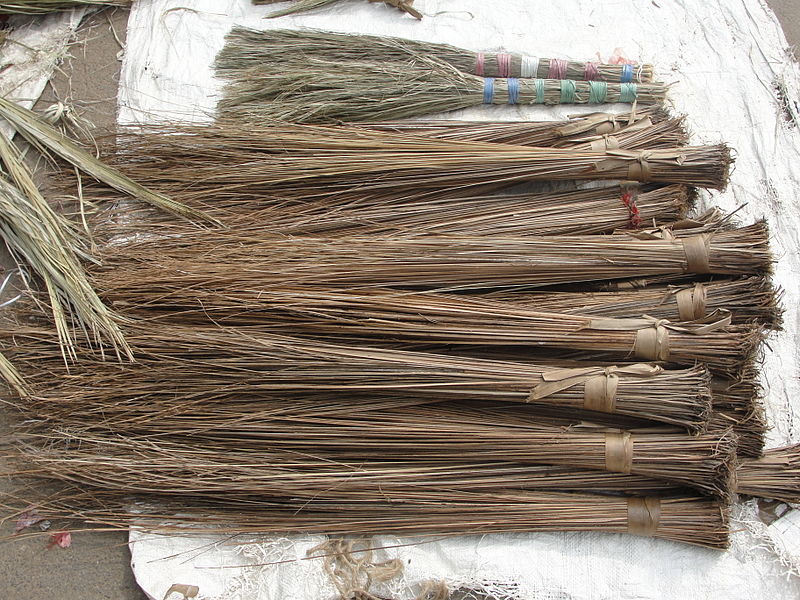
When I was better practiced at my meditation, I received a visual that stayed with me long after. I saw a man with dark curly hair, stepping out of a large forest with four or five handmade brooms slung over his shoulders. He was wearing a simple shirt and loose pants with boots on his feet, all of an indeterminate time period. He was leaning against a rough lumber fence but he looked at me, looked me in the eye. The sensation that only happens in the physical world was there. He was looking at me.
I began to meditate at night on that image, willing it to me, calling him back. I opened myself up to receive any message he had to share, but what I got were more brief flashes of images that meant nothing to me. Eventually, I started to feel a presence in the house that brought with it the sweet smell of pipe smoke. In my gut, I knew it was him. Whether he was an actual ancestor, or a metaphor for that cultural bloodline, I didn’t know, but I started paying attention.
I thought that the male spirit I was entertaining was Polish or German, both of which I know are heritages that live in my blood. Later, when he spoke in my journeys, it was German, and we found ourselves at an impasse. I had sung enough songs in German to recognize a few words but that was the extent of my knowledge. Several of my houseguests eventually experienced physical contact with the spirit, accompanied by the smell of sweet pipe smoke and I used to joke that he must have thought I was dense, requiring him to seek help in getting my attention. We all called him The German Guy.
On a whim, at a wedding rehearsal party, I asked my mom what she knew about our German heritage. And my mom told me stories about her bootlegging German grandfather, where his house was when they went to visit him and what it looked like. She even remembered the song he used to sing to the sound of his windchimes:
                        How dry I am, how wet I’ll be,
                        If I don’t find, the bathroom key.*
In the back of my head, I heard the German Guy sigh. I don’t know who he is or if he, in that shape, means anything to my lineage. But I liken him to the visual representation of my German heritage, to all the Germans standing in my ancestral tree. To the known families of Art, Arth, Schmeelk, and Pils. To honor them, I leave an offering I saw in one of my meditations, of dark German ale with chunks of hard bread softening in the bottom and I thank them for their lives. And I thank them for mine.


*A brief web search led me to the information that this was a common folk rendition that was a runaway from a small lyric of the Irving Berlin song “The Near Future”, written in 1919, during Prohibition.
Creative Commons License
This work is licensed under a Creative Commons Attribution-NonCommercial-NoDerivs 3.0 Unported License.