Remember...

Ancestral energy lives in the stars above us, the stones beneath us. Their memory gathers in oceans, rivers and seas. It hums its silent wisdom within the body of every tree.

Showing posts with label holidays. Show all posts

Wednesday, December 22, 2021

A Century from Christmas to Solstice

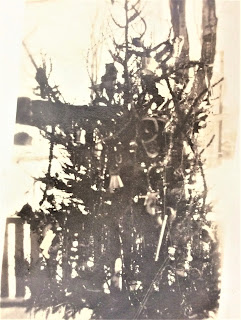
I am very blessed to have photos of my ancestors' decorated holiday trees from a century ago. How wonderful, right?!

This first photo was taken-- probably around 1920, based on the ties under the tree, by my mom's maternal Art family. George and Katherine worked as groundskeeper and housekeeper for the Kenan family in Lockport. It's hard to say who the family photographer was, as the whole family appear in front of it at some point. The two sons appear least frequently. My guess is the camera was a gift to the family from their wealthy employers.


This photo was taken in 1922 by my dad's maternal Wicker family. Minnie Wicker's father was pretty well-to-do and she had her own camera and was quite the photographer for most of her life, which is a blessing for us, as her daughter, my grandmother, died when my dad was quite young. We are thrilled to have photos that span her entire life, from birth to marriage, to children of her own. We're blessed to have many of Minnie's photographs, including this one of a Christmas tree on their front porch.


Third photo is my family's Winter Solstice tree taken on night-vision setting, 2021, almost exactly 100 years later. While our religious beliefs may differ, we honor our traditions in the same way; by lighting hope in the darkness.

A century ago, our ancestors would have just been recovering from the two years of flu that crippled the country, not unlike where we are now. I'm thinking about my family, across the miles and generations, gathering together, celebrating the importance of togetherness and fellowship.

However you bear witness to the holiday season, whatever it is you celebrate, know we are following in the footsteps of Those Who Came Before Us, coming together to mark the turning years, looking behind and looking ahead.

Wednesday, December 18, 2019

Ask Your Family Their Stories


Grandma Ruth in red & Great-Grandma Hattie in blue.
Many of us are getting ready to spend time with our families for whatever holidays we celebrate. This is a perfect opportunity to ask your elders questions about their childhoods, their parents, their grandparents, or any family stories they remember hearing. 

Where were they born? What was their first job? What was their favorite childhood book? Where is their favorite place in nature? Did they have a signature food dish? Known hobbies?

Who were their heroes? Did they travel? How much school did they do? What did they dream of being when they were kids? 

What do you want to know?

Even better, make a list of the questions you have, slap a fancy holiday image at the top and hand them out to your family. Take videos of them answering some of the questions. Make it communal.

Doing my genealogy as an adult and getting more context for names I heard bandied about as a kid, I realize all the moments I didn't pay attention to. I mean, we all do that. Kids aren't supposed to pay attention to that stuff. And they're not going to pay attention to boring grown-up talk unless we lend sacred weight to; there are ways to ritualize storytelling.

I'm trying to learn that.

I never met my paternal grandma Ruth Emma Ruston. She died at 42 of cervical cancer. (That's a year younger than I am now.) She’s the woman in the photo, in the red dress, at a family function shortly before she went back to the hospital for more treatment. When my dad showed me this picture, he got choked up. I’d never seen it before.

He doesn't remember that day. He was only five. But he'd been told a story that he shared with me.

When Ruth was 42 she had four children. The oldest was 19 and my dad was the youngest. He said that Grandma Ruth went to an afternoon function in that dress because it was her favorite. She knew she wasn't coming back from the hospital and that red dress was her favorite. And I fucking love that.

My dad asked his older brother, an adult when she died, if he had any special recollections about her. We didn't expect him to sit down and write down as much as he could recall. I cried reading through it. If my father had never asked, I wouldn’t know.

I feel like I know her better now. She was clever and inventive and creative about finding ways to run her household that positively affected her community. She loved her family fiercely for as long as she could.

Think about what you want to know and ask your questions this holiday. You won’t always get answers but you might just learn more than you expected. You might learn a small detail that helps you unlock another level of your genealogy work, but you’ll definitely make more family memories in the sharing.

Tuesday, December 20, 2016

Modraniht, id est matrum nocturum

“the Modraniht, that is, in the night of the mothers[=matrons?]”

History
I came across this celebration when I was researching the pagan roots of my German ancestors. Early Germanic peoples celebrated the night before Winter Solstice as Mothers Night. The Venerable Bede, a Christian monk from the 8th century wrote about it in his description of the pagan calendar. In Old English they called it Modraniht. More than 1100 votive stones and altars have been found through the centuries, dedicated to the mothers, or matrons, and half of these altar stones were inscribed and dedicated with Germanic names.
The main areas of worship have been uncovered in ancient Germania, northern Italy and eastern Gaul. There are a few larger cult centers with temples found along the Rhine. Many of these altars were found near rivers, wells or springs. The dedicated altars and votives reached as far as present day Scotland, southern Spain, Frisia and Rome. There is reference to the Germanic Mother Cults in the writings of Bede in 725 AD: “And the very night that is sacrosanct to us, these people call modranect, that is, the mothers’ night, a name bestowed, I suspect, on account of the ceremonies which they performed while watching this night through.”
Altars and votive stones, as well as temples, were often carved with images showing three women of matron age and appearance, often holding baskets of fruit and a baby. Based on the inscriptions found, it is thought that these altars were dedicated as offerings of thanks for abundance, gifts and blessings that soldiers and sailors had already received. They believed the Mothers had responded to their prayers and this was their way of acknowledging them, burning incense and leaving sacrificial offerings of food.
Many of these goddesses or spirits were named for the family that was dedicating them, as well as being named for the river or spring that watched over the local town or village, such as the Albiahenae matrons of the town of Elvenich or the Renahenae of the Rhine. Of the 1100 votive stones found, over 360 different ones name the same sets of matrons, the Aufaniae, the Suleviae and the Vacallinehae. Based on the age of the stone inscriptions, it appears that the cult of the Matrons began to die out in continental Germany around the fifth century CE, and Modraniht fell out of favor as Christianity gained foothold.

Home
The Night of the Mothers was the time to honor the familial and tribal “soul” mothers who watched over them. It was intended to honor those who had crossed over, not for those still living. On Mothers Night we honor the sacrifice of life so that the ancestral matrons might become a source of wisdom and strength for those still living.
I begin my celebration by creating a small rock cairn on a temporary altar. I honor first those of my mothers who have crossed over, inscribing their names on stone in chalk. I light a candle for each of them. I remember them and tell what I know of their stories. I do also choose to honor the strength of the mothers still living, that they may become part of that ancestral current when it is their turn to pass through the veil.
I drink a cup of tea and invite them to share my cup. I crochet, something my Great-Grandmother taught me on the front porch over the summer when I was younger, gifting me her hooks when she could no longer use them. One way to honor the mothers is to honor their work and pass on the skills that have been taught to you by your mothers, and their mothers, that they live on through you, and the crafting of your hands.
What was special to them? Before dusk falls on Modraniht, I sit and hand-sew, darning old clothes. With each stitch, I pray. Tonight I stitch runes of rebirth, recovery, and courage into cloth. Each stitch is a small prayer of hope, a way of pushing forward despite the adversity.
This night is the night for daughters and sons to honor the line of birthings that occurred throughout history, that opened the way for their births. That made their presence in the world. It does not matter what current feelings might be complicated around maternal relationships.
You are because they were. Do not rewrite the past. Honor the journey.

Heartsong
A year ago I prayed to my mothers from a hospital bed on the rehabilitation floor. I thanked the spirit women who stood by my bedside on the Burn ICU. I thanked the faces I recognized from photos and the ones I may never identify.
            Again, I pray for them. I thank the ICU nurses who mothered me back to health and back to myself. I thank and pray for everyone who had hands in easing my recovery, brightening my heart, or tended to my body needs in any way. And this year I thank the courses my brain stories took that enabled me to step out of the fire without succumbing to madness.
            In light of that new prayer, I light a candle for the mythological goddess Frigga, who sheltered me in the darkest moments by wrapping what was left of my bones in a cool cloth and tucked me away from the glare of the blinding sunlight. In the next moment, in my ICU bed, I knew a moment of relief.

Hearth
I am Sarah,
daughter of Margaret,
daughter of Patricia,
daughter of Margaret,
daughter of Eliza,
daughter of Mary of Ireland,
daughter of mother unknown…

Daughters of daughters back to the first mother,
I pray to you in stitches.

The needle between my fingers devolves into metals of various kinds, into bits of bone, until my hands roughen, becoming one with the first hands of my line to stitch skins together. Whoever is unknown to me, whatever countless number of generations of mothers led to my birth, we are joined in this familiar act.

I pray for health for my loved ones.
I pray for my continued healing and recovery.
I pray for happiness for all who walk the earth.
I pray for moments of joy for all who are grieving.
I pray that the echo of the wisdom of the mothers who have come before is remembered.
I pray for the earth, for our Great Mother, whose bones and minerals and animal DNA gave us life.
I pray for all mothers who came before me, all who walk with me and all who will come after... though my line ends with me.
May my life touch others while I am living it.

Grandma Donna MacDonald (m.Riddle)

Grandma Ruth Emma Ruston (m.Eaton)
1xGG Minnie Estelle Wicker (m.Ruston)

1xGG Hattie Eva Smith (m.Eaton0

2xGG Ruth Ireland (m.Ruston), Grandma Ruth Emma Ruston, 2xGG Emma Angeline Whitcher (m.Wicker)

2xGG Hattie Eva Dutcher (m.Smith)
2xGG Theresa Cordelia Tenney (m.Eaton)

2xGG Frances Gillette (m.Riddle) back, far left, & 3xGG Jane Berry (m.Gillette) front, right

3xGG Eliza Marsh Bird (m.Dutcher)

3xGG Sophia Sears (m.Smith)

4xGG Mary Ann Boots (m.Gillette)

4xGG Elizabeth Ann Hill (m.Berry)


[Adapted from an article originally published December 21, 2011.]

Wednesday, December 7, 2016

Human Kindness

One of my favorite things about the holiday season is witnessing moments of kindness between strangers as these events occur with more spontaneity at this time of year. Allow me a moment to plug the notion that we can carry Christmas and Solstice with us through the whole year. Human kindness always moves me and makes me misty. The most memorable and heart-warming moment I remember happened during the holidays of 2001.
The day of the attacks on the twin towers happened the September day before I was to start training as a cashier at a local grocery store. We had recently moved to a new city and spent the day of the attacks glued to the television we hadn’t even had hooked before we heard the news. When I clocked in the next morning for training, everyone was in a state of horror and shock.
I hadn’t been there long enough to know any of the regular customers yet, but what I saw were couples and mothers shopping to feed their families, day in and day out. It was their only agenda. They all had different colors of skin and different styles of dress and each of these was widely varied. After the attacks, I saw the majority of my community respond fearfully to the women in their abayas and hijabs.
In their fear they were not kind, and they felt free to make horrid comments to the women shopping that I cannot even write out for you. They literally walked up to unveiled Muslim women shopping, minding their own business, and accused them of killing people in New York City. Of hiding weapons beneath their abayas and demanding to see what was hiding underneath them. And much, much worse. In front of their children.
And what will those children grow up thinking about their place in the world?
I am grateful that my grocery store allowed the cashiers to refuse service to those customers who would not cease in harassing the Muslim families. And I did. Often, at first. I have always believed in kindness. It is always heartbreaking to me how cruel people can be from a place of fear.
What is it that makes us lash out like wounded animals at each other? How does hurting other people make us feel better? I understand being afraid. I understand having fear. We are each allowed to feel the emotions we feel. But we are not allowed to inflict them on others. We are not allowed to wield them like weapons against other people. We are all animals. That is true. But it is supposed to be our human compassion and brains that lift us above our animal nature.
Every day, those interactions were the shadow that fell over my joy of getting to know the community here and its humanity. I saw too much ugly at first- which may have been true wherever I found myself then. One day, on a holiday shift, one man’s generosity renewed my faith in the goodness of people. One small act of kindness was enough to tip the scales.
A Muslim man and his wife came through with their young son, buying healthy grains and vegetables and fresh meat and milk and eggs. It was the healthiest display of food I ever saw anyone bring down my register in all of my time at the store. She wore an abaya and hijab but the old couple before them paid quickly and muttered about letting burkas in the store.  
The electronic benefits line was down, as it often was back then, and their EBT card was denied. They began to count out their cash and put things big extras back, like the asparagus and the turkey. When they took back the only other extra, the box of cereal for their son, he did not cry in complaint. That moment stayed with me. It was obvious they were struggling to decide what else to take away.
An older man behind them asked me how much more they needed, while they sorted through their groceries. They only had twenty dollars and I whispered apologetically to him that they needed another eighty to cover everything, and that our system was down- that it wasn’t their fault. I was so used to customers being impatient and wanted him to understand the technology glitch was no one’s fault.
The Muslim woman started to apologize nervously to everyone in line around the same moment. But the man behind them smiled compassionately and handed me a hundred dollars. All he was buying for himself was bread, lunch meat and milk.
At first the couple would not take it, but he insisted. I will never forget what he said. “You need help, and I am in a place to give it to you. I would like to think that when I need help, someone will be in a place to give it to me.” The family thanked him profusely and gratefully. You could see the surprise wash over them. As they were leaving, the husband turned around and told the man that he would never forget his kindness. And the man shrugged it off, “Just repay the favor some day.”
When they left, the man would not hear me say anything about it, waving my gratitude and tears away. He said it wasn’t a big deal. “It was to them,” I assured him. And it was to me. I have never forgotten it either. I have paid it forward innumerably.

Sometimes kindness comes in the form of a simple smile. Making eye contact with your cashier during your holiday shopping. Taking a moment to saying thank you to all of your cashiers, to the waitress when she brings you a new drink, to anyone working in service for you. There are a lot of people in the world and we don’t know everyone. But at some point in our lives, even our closest friends were strangers to us. And every stranger is someone’s son, daughter, mother, father, friend. We have choices every day in what face we show to the world. Spread compassion and kindness throughout your days. It is the simplest and most beautiful language we can share and it is a language that will shape the world around us into a brighter place.


[Updated from “Human Kindness” published December 4, 2013.]

Wednesday, December 31, 2014

Great-Grandma Hattie’s Diary


My dad has an old metal toolbox, inside which lies my great-grandpa Royal Levant Eaton’s wallet, a true leather billfold. Inside that wallet, I found a small scrap of paper folded up. It was a page from “Our America Engagement Calendar for 1956”. On the other side of it was a brief holiday journal written out in green ink by my great-grandma Hattie Eva Smith.
By the end of 1956, Hattie had been widowed for twenty-five years. My great-grandpa Roy was a prison guard. His son, my grandpa Mark, was sixteen years old was his father was injured during a prison riot and later died. Hattie was left with three children- Helen, Dorothy, and Mark- and had to get a job. She went to school for nursing.
In the journal bit she tucked away, it was Christmas time for her and it is Christmas time again. I corrected her major spelling and grammar errors, but otherwise, I’d like you to meet my great-grandma Hattie, in her own words. She mentions her daughter Helen, who shared an apartment with her. It’s worth noting that Helen was rescued by her brother and his brother-in-law from an extremely abusive relationship. 

December, Sunday 25: Snow all gone and it is Christmas day. Went to Mark’s for the day. Had a good time. Phil’s so cute (that’s my dad!). They sure had a nice Christmas, so glad. They deserve it. Robert and Laura were there for dinner. Mr. and Mrs. Rauson [Ransom, Mark's boss] came in to call.

December, Monday 26: Dorothy came after us and we went down there and had a lovely time. Jack sure had a good time. I know I did. Helen did too and looked better in a short while after we got there.

December, Tuesday 27: Cold day. Helen went to library. Very quiet here. Looked over my xmas presents. Read. Took a nap. Washed a few clothes. They are like boards they froze so stiff. A bit tired today. So much excitement!

December, Wednesday 28: Lovely day. Dorothy came for a little while. Bertha wanted time to go to the movies. We went to Bob’s for evening and had a good time. They sure had a big Christmas. Wish I could do for mine

December, Thursday 29: Went to the movies to see Heidi also Vanishing American. Helen was mad when she found out Bertha paid for it. She wasn’t too nice about it but so it goes. She is so sore at life.

December, Friday 30: Cold. A snow squall this morning. My check came this morning. Will pay the rent 46.00 tonight. Church $10. Also $8 for Miss Schafer for underclothes; slips. Helen’s so depressed over (?)el(?)(?).

December, Saturday 31: This is the end of the year. Hope next year will not be so hard. Have done the best I could. What more can anyone do? Good bye, old year. We hope for better times.

            At this year comes to an end, I feel a kinship with this woman I have never met. After I read the small diary to my father, he talked fondly of her and described the layout of her small apartment to me. I live in my own fading apartment and have spent a year barely getting by, trying to focus on the joy that we are still getting by.
In difficult times, the love of the people in my life is my sunshine. I wonder if it was the same for Grandma Hattie. Because in that respect I am fully blessed. So I’ll borrow her words, her silent prayer, as I greet 2015. This prayer is for me, for my family, and for the world around me.

“Good bye, old year. We hope for better times.”

Wednesday, December 24, 2014

Talking Tradition on Christmas Eve

I alternately titled this post “Love and Magic”, but I thought that might be too abstract. Or too simplistic. I’ve been thinking a lot about traditions this season. The ones I have are the ones I grew up with and I realized how strongly my personal traditions were dictated by my childhood. Can I call it a tradition then?
Somewhere in my head, tradition means something done because it has always been so, passed down through generations. But in my heart tradition means something done because of an emotional connection/response to it that it bears repetition. Or something like that.
I think something can be both a tradition and an adaptation of the original. I don’t have children, so I couldn’t do Christmas exactly the way we had or it would be less meaningful. What my parents did was to serve us a feeling of wonder and joy. I hold onto the essence of that tradition.
When I was a child, we opened up our stockings while we waited for my Grandpa to arrive. He was always there when we opened our presents. While the coffee brewed and the cinnamon buns baked in the oven, we would eat the orange from our stockings. The coffee was for my grandpa. The cinnamon buns were an annual treat.
It was years before I realized that my Grandpa got up every Christmas early in the morning with my Grandma, who always worked the morning shift at the hospital, so other nurses with children could be home with them. They’d have their Christmas morning together before she left, before dawn. Thank goodness Santa had already been there, I thought when I was little. My Grandpa would spend a quiet morning until we called him.
It was never more than eight or ten minutes before he arrived. Which is forever to children on Christmas morning. We would jump when he walked in the door, never wanting to give him a chance to take his coat off. My parents would chide us but he understood. Grandparents always understand.
I envy him that stillness he enjoyed, now too old to ignore the fast-paced world around me. So part of my adult tradition has become that we open our stockings first, slowly, to prolong the morning. We bake cinnamon rolls while we eat oranges. And before we get around to exchanging presents, we leave a sweet roll and a cup of coffee on the table near us. It’s been a decade since he passed, but my Grandpa has never missed a Christmas.
Traditions become habit and sometimes, they get lost in translation, though the heart of them remains. It stirs my creative juices and I can see an alternate future in my mind. If I had children, and they passed down the traditions I shared with them, how might that evolve? How might descendants who come after us, who could not know us, adapt such a small gesture?

Raya carried the heavy tray from the kitchen into the living room where her family waited. Her hands were sweaty but she pressed the metal against her belly for support. It was the first time her mother was allowing one of the kids to perform the ceremony. Her sister Krina said it was bad luck to even stutter or trip over a word, and Raya’s tongue was often slow. She didn’t need more bad luck. The young girl’s bare feet padded quickly across the floor and she held her breath as she set the heavy tray down.
Her family waited in the dark room around a small tree aglow with brightly colored lights and hung with small paper ornaments covered in wishes. They wrote out wishes for everyone in their family each year. Raya had spent time on her wish for her younger brother Bitt, who currently fidgeted, looking longingly at the tree.
He had dark features, like her mom and her dad, and her two sisters. Only Raya bore the pasty skin offshoot of some distant relative, freckles dappling her nose and cheeks. Their family photos were humorous.
She reached up for the shelf above the tree, where an old ceramic mug sat. Its handle had been glued back on a few different times over the years. It was the cup her mother had grown up using, cool against her skin.
She lifted a steaming pot from the tray and poured the rich brew into the cup. She held her hand steady. One seamless pour. Not a drop wasted. She raised the cup up and set it on the shelf beside faded ancestor photos.
Raya took in a deep breath once the cup was out of her hands. She bowed to the shelf and the offering, before walking to the door. She opened it out onto the street. “We invite the grandfathers and grandmothers. We are because they were. Be welcome. Be warm.”
Her family echoed. “Be warm. Be welcome.”
Winter winds swept into the house and Raya shivered. As she closed the door, the other children ran to the tree, where a present waited for each of them. Raya ran to join them but her mother caught her by the hand, pulling her into a hug.
“That was beautiful, my darling,” her mother smiled. “Happy Solstice.”

I see love in that. We may not have known our great-great- or great-grandparents but, in some way, we do. Our grandparents raised our parents and our parents raised us. Other hands and hearts raised our grandparents. We know them in the traditions that have been passed down, the ones that have meant enough to be carried on. Whether we know the stories or not, their origins are in love.
Magic, wonder, and love are the legacy left in the wake of meaningful traditions. Whatever you practice, whatever you believe, whatever you celebrate at this time of year, that holds true. As your family gathers together this holiday, be sure to share the stories associated with them.

Many blessings to you and yours.

Wednesday, December 17, 2014

From Samhain to Solstice

Spirit energy is thick in the days between Samhain and the Winter Solstice. I refer to it as the Fallow Time, when things are stilling and resting and the restless spirit lies just beyond the next breath. Spirit world isn’t something that opens to us one night a year. It’s always there. Only sometimes we don’t see it and sometimes we do.
It doesn’t surprise me that Dickens found himself inspired to write a story about ghosts haunting a miserly man at the holidays. I feel them more strongly at Solstice than at Samhain. I know I’m not alone.
Every year, I write out holiday cards to friends who celebrate Christmas, Yule, Solstice, Hanukkah, and some who don’t celebrate anything in particular, but the joy and humanity of the season. They are living ghosts, mostly people I do not see often or haven’t seen in the decade since my move. The cards are my way of reaching out to those who are important to where I have been and who I have become. It’s my way of telling them I still carry them in my heart.
While I fill out the holiday cards I reflect on those who are in my web and the changes in their lives since last year. Three of my beloved families are celebrating their first holiday with a new child. So much love! I have five changes of address this year of people who settled into their own homes for the first time. So much joy!
And where there is light, there is always shadow. I discovered a family friend had passed when his name was left off a card I received. I had known he was sick, but didn’t realize he was gone. Blessing or not, I will hold that sadness gently this holiday.
As I filled out a card to my Grandma, there was a bittersweet moment where I left my Grandpa’s name off, and I paused. He passed this last spring. I remember how frail and bird-like my Grandma seemed when I saw her in July and my heart is heavy for her and how she will experience the holidays this year.
I feel the memories of every holiday that has happened in my life overlaid in song, as if the ghostly echoes of each one plays out overtop the other... knocking on the table during scat with Grandparents after family dinner... singing carols for other Grandparents’ drunk friends... driving around to look at holiday lights... the reveal of the Christmas tree in the morning, like a flip book, as year after year unveils...
It is happening to me and it has already happened. Is that not the definition of a ghost? A spectre that you see, that cannot be because it has already been? I am everything I was and who I was is why I am who I am.
Only I am no bitter miser. I see Scrooge’s Marley visitation and I raise him the Christmas orange that vividly puts flesh on the ghostly spirit of my Grandpa Dick’s. Each Christmas morning, we would be peeling and eating them when he arrived, waiting for him so we could open our presents. A ghost brought to life with bits of my memory and a gallon of love left behind. I think of all the years as I crochet at my desk, feeling the familiar weight of a cat on my lap who cannot be there because she has been dead for four years.
At this time of year, and always, I accept what I experience as true because what else can I do? I allow my thoughts to drift to those who are no longer with me because at the holidays it’s easier for me to remember the joy of the lives that touched mine over the sorrow of their absence. So I truly cherish it. The sound of my Grandpa’s chuckle and my Grandma’s giggle warm my heart and I bid them to sit in my kitchen, in my home.
Come Yule, I will leave a glass of spiced wine for my friend who passed, an annual gift he loved. And on Christmas morning I will leave out a cinnamon bun and a cup of coffee for my Grandpa. I will take the sadness I feel for those I wish were alive still and transform the sorrow into love, for the only true answer to sorrow is love.

I mean, what if everyone fed their love into the holiday season this year? What if everyone in the world shared love and joy and good will to all men?  I will sit with the spirits and pray for peace and I will gift the world my love and joy, in honor of those who can no longer do so.

Wednesday, December 3, 2014

The Gratitude Jar

My friends and I share a common form of gratitude mindfulness, though we practice it in various ways. It’s easy to find gratitude at the holidays when our family is gathered together and we are visibly reminded of our blessings. It is often harder to feel those gratitudes the other ten months of the year.
My family and I do something for Yule, which could just as easily be done for Thanksgiving. It involves just a tiny bit of preparation, which we start around now. We make ourselves a gratitude jar.
You’ll need a jar or a canister of some kind. Tie a ribbon around it. Cover it with a collage of magazine pictures that make you think of gratitude or joy. Put it somewhere visible, but out of the way. Better yet, stick a sign on your fridge with the word gratitude on it as a reminder. Preparation is done!
Then, throughout the year, it becomes an exercise in mindfulness. I try to do one every week, one thing that I am grateful for, one thing that that made me smile, that made my life easier, that made my view of the world brighter. I have found that the true trick is not to put “family” or “work”. Instead, try to put into words what it is about those things you are grateful for, like: “I am grateful for a partner who makes me dinner when I am fighting a deadline” and “I am grateful for the editor who accepted my story.”
And watch for what I call back-handed gratitudes. They fool a lot of people into thinking they’re being grateful. You might think this sounds honest: “I’m glad my husband finally did the dishes without me having to ask him to.” And it is honest. But it’s a gratitude that hinges on an underlying unhappiness. Try not to qualify them. A better way to think of it would be: “I’m grateful my husband did the dishes tonight.”
In gratitude work, the way you say it highlights how you feel it. Gratitude comes from your center. Experiencing gratitude will change the way you see and verbalize the blessings in your life. The way you learn to convey the gratitude you feel will help you experience more gratitude in your life.
Get your whole household in on it. Write down the people you are grateful for as they help you or lift your spirits. Write a gratitude for the neighbor who helps you jump your car when your battery dies. Write one for plants gifted to you in the spring, just when you thought you weren’t going to be able to budget it in. For the day you sat so quietly in the woods that a bird landed on your head. Write down moments you have that fill your heart with joy and wonder.
And then, next holiday season, between November and January, take turns reading them out loud, a few at a time. Fill the season with reminders of your blessings.

Or, save them. And on a dark and bleak day, when you’ve hit your wall and don’t think you can survive another day of it (we all have them), pull one out and let it be a light for your soul. Let it be a reminder to you of the bright days, a reminder that the hopeful days, like the sun, return.

Wednesday, January 8, 2014

My Father’s Father: Mark Dutcher Eaton

Mark & Ruth Eaton
My grandfather’s name was Mark Dutcher Eaton. My dad was 28 when his father died. I am a decade past that age myself, and my heart breaks for him to think about it. I can’t imagine losing my dad now. I really can’t imagine not having had him in my life for the last decade.
I only have one strong memory of my father’s father. I had just turned six when my Grandpa Mark died. He had cancer. I have a softer memory of him, just before he passed, lying on a green couch in the front room of the house, covered in an afghan while we visited. Other than that, I have just the one memory of him that I have held tightly to.
I have protected that memory from alteration and exaggeration. I keep it sacred; it has always felt important. I think of it every holiday season. I do not know how old I am in the memory, but I am staring up at him and he seems seven feet tall. And in the memory, my Grandpa is healthy.
We stop in to see them on our way to dinner somewhere. I like coming here. I like the stone fireplace. My Grandpa smiles the biggest smile and asks us if we want a cookie. My parents protest but he isn’t listening. They acquiesce but tell us we can only have one while he is gone from the room (and they mean it).
He comes back from the kitchen with a round tray full of different kinds of cookies. He says we can have whatever we want but our parents’ eyes are on us. I can’t decide. I look up and he is smiling. It is such a bright smile. [As a grown up, when I see that smile in my memory, it reminds me of what delight looks like]. I take a cookie. I don’t remember which kind I picked. But I remember that he’s wearing a sweater. I remember that I barely know him but I know he loves us.
Thus endeth my memories of Grandpa Mark. If I was a couple of years younger, I wouldn’t have any. So I am grateful for it, grateful for that vision of his smiling face.
Still, I wish I had more memories of him, or knew more stories of what he was like, something I intend to rectify moving into this new year. Not just him, though. My family didn’t spend a lot of time talking about those who had died with us kids, though I do remember hearing them talk about people we’d never met. How could we have contextualized unknown names and faces when our worlds weren’t any larger than our immediate families with their smiling faces and warm laps we felt free to climb up on?
A large part of this ancestor work for me comes from wishing I had asked my grandparents and great-grandma about their parents and grandparents when they were still alive. But I didn’t. What I can do is to try to collect what stories can be found for my nieces and nephew. After all, names and dates don’t tell you about who they were. And having more personal context helps you connect to those you did not know.

What about you? Do you know who your parents’ parents were? Or their parents? Why not start off the new year by honoring the loved ones who are no longer with you? Remember them. Pick a memory of those you lost, of your grandparents and your great-grandparents, maybe siblings and parents if you have lost them. Write out the memory of them for the children that will come after you who never knew them or might not remember that they once did.

Wednesday, December 18, 2013

Grieving at the Holidays

Here is one of the ways grief works in our minds… I fall asleep thinking about my new cat, and how quickly she slipped into her own night time pattern. And how different her pattern is from any of the other cats I’ve had. Had. Because they’re dead now. Bella died in June. Bella hasn’t even been dead for a year. Bella’s only been six months. And I miss her. As cute as Mara is, she is an addition, not a replacement. And I want to have them both. Then I want all five of the deceased and alive cats all in one space. In one time. Right now.
And then I remember that time is a cycle of wheels and gears interlocking and pulling away. Some return to meet over and over and some gears only touch once before travelling onward. Our lives are these wheels within gears, within circles of family and friends. We need time and distance to distort the powerful emotion of feeling all that love at once or we would explode from the wonder of it. But sometimes, in the wake of the awe, we forget that these cycles and shifting circles are what our lives are made up of. And grief is part of that cycle.
I remember Bella’s night time pattern. Every night, before sleep, a kiss on the nose. If I forgot she would cry at me, kneading her feet angrily or worriedly on the bed. It was never the same emotion. And I remembered them, every one of those separate occasions as if they were a flip book of images in my mind until they became the same still. A thousand emotional moments becoming one feeling, one memory, and bringing her back to life. I could hear her tinny, obnoxious cry. And I could feel her coat under my hand. I could feel her push her face against my lips. I started to cry with a kind of grief I haven’t let myself feel for months.
The house is decorated for the holidays. We give our cats a stocking of toys and catnip in the morning. It was hard enough when Luna died. This year, Bella won’t be there either. I know our holiday morning will be bittersweet, making new memories while being haunted by old ones. It’s why learning to be in the moment is important. This year, more than any other, I have a long list of friends who are dealing with the loss of a parent or pet, most of them within the last few weeks. It’s the cycle of life. And it’s heartbreaking.
It’s hard to lose someone at the holiday season. And it’s hard to be missing them when we are focused on family and loved ones. The weight of our grief directly correlates to the weight of the love we held for the lost. And when we are surrounded by family, by joyous, loving emotions like the holidays evoke, some of that grief will seep through. The most important piece of advice I can give you is to be gentle with yourself. The holidays are about compassion and you have to start with yourself. There’s no timetable for grief. What takes some people months, takes others years. Even then, it never truly goes away. The loss is always with us. So go easy on your grief and let it flow through you.
The other day with friends, I realized that I would never say to Bella again, “Nobody wants your anus,” as she was prone to presenting it to people in greeting. I cried for a minute, out of nowhere to my friends. They asked what was wrong and I told them and immediately laughed through my tears, because it was such a strange thing to miss. I said that it was stupid and my friends said, No. It wasn’t. And they were right. The tears gave way to smiles and funny stories and the day went on. I didn’t ruin it with my grief.
So who cares if you’re at a holiday party and you think about your dad and you cry. Everyone loses people they love. Everyone understands. And if they don’t, maybe we need to make them. I shed a tear for my Grandpa every Christmas morning when I eat my orange, because he’s not here.
The last Christmas together, 2009.
It’s when we hold our grief in that it eats at us and it hurts. That’s when keeping it behind walls until it bursts out ruins our days and moods. At the holidays, it’s impossible not to think about our fresh losses. We’re afraid of our grief. We’re afraid to bring it up because of the tears that threaten to follow. But what doesn’t work through us lives within us. So those who are grieving need to be able to be sad so that we can push through the crust of grief to the happy memories underneath it. The swifter you allow the flood, the sooner it ebbs.
If you aren’t the one grieving? Give your friends a break. Invite them to your festivities even if they’re dealing with a loss. Remind them they still have you. Be understanding if they choose not to come. Be understanding if they show up and are not the life of the party. Holidays are not about how things look. They’re about brotherhood and sisterhood and compassion.
I spend a lot of my time hanging natural ribbons on trees in memory of those no longer with me. So I both make and collect ornaments that do the same thing. I have an angel cat for both Luna and Bella. A hummingbird for my grandparents and an owl for my grandma. You could also get some heavy card stock and cut out suns and snowflakes. Write the names of your Recent and Beloved Dead on them and hang them on your tree.
Drink a toast to those you miss when you are all gathered together. Have everyone raise a glass and speak their name. Share funny or heartwarming stories about them. Set a favored cocktail out on a clear space as an altar and offering for them. Bake the cookies they loved or used to make themselves and share them.
Put out a bunch of tea lights and candles, unlit. Throughout the day, as you remember a happy memory, light another candle. Literally allow the love and memories you had to bring light into your holiday. The darkness of winter seems to last forever, but this is when the light begins to return. I use the holiday as a reminder that there is joy after the sadness. Grief may pull at our hearts but love will win out in the end.

Blessings to you and yours this holiday season. 

Wednesday, December 4, 2013

Human Kindness

One of my favorite things about the holiday season is witnessing moments of kindness between strangers. These events occur with more spontaneity at this time of year than any other. The most memorable and heart-warming moment for me happened during the holidays of 2001.
The day of the attacks on the twin towers in September happened the day before I started my training as a cashier at a local grocery store. I had moved to a new city that summer and spent weeks unable to find a job. I spent the day of the attacks glued to the television we hadn’t even had hooked up yet. When I went in for my training, everyone was in a state of shock and horror.
It wasn’t just the people working there. It was everyone coming in to shop as well. The city I live in has a large refugee and immigrant program and there are a lot of veiled Muslims who live here. They were here before the attacks and here after. But what I witnessed after 9/11, in the store, was horrifying to me.
I hadn’t been there long enough to know any of the regular customers yet, but what I saw were couples and mothers shopping to feed their families, day in and day out. It was their only agenda. They all had different colors of skin and different styles of dress and each of these was widely varied. After the attacks, I saw the majority of my community respond fearfully to the women in their hijabs. In their fear they were not kind, and they felt free to make horrid comments to the women shopping that I cannot even write out for you. They literally walked up to the veiled women shopping, minding their own business, and accused them of killing people in New York City. Of hiding weapons beneath their hijabs and demanding to see what was underneath them. And much, much worse.
I am grateful that my grocery store allowed all of the cashiers to refuse service to those customers who would not cease in harassing the Muslim families. And I did. Often, at first. It is always heartbreaking to me how cruel people can be from their place of fear.
What is it that makes us lash out like wounded animals at each other? How does hurting other people make us feel better? I understand being afraid. I understand having fear. We are each allowed to feel the emotions we feel. But we are not allowed to inflict them on others. We are not allowed to wield them like weapons against other people. We are all animals, that is true. But it is supposed to be our human compassion and brains that lift us above our animal nature.
It was the shadow that fell over my joy of getting to know the community here, the humanity of it. And then the holidays happened. One day, in one shift, one man’s generosity renewed my faith in the goodness of people.
A Muslim man and his wife came through with healthy grains and vegetables and fresh meat and milk and eggs. Honestly, it was the healthiest display of food I ever saw anyone bring to my register in all of my time at the store. The couple were traditional and she was veiled. They had a small child with them and when their EBT card was denied (the system often went down, which had happened that day), they began to count out their cash and put things back, like the asparagus and the turkey and the box of cereal for their son, who unlike most children, did not cry in complaint. It was obvious they were struggling to decide what to keep.
An older man behind them asked me how much more they needed, while they sorted through their groceries. They only had $20 and I whispered apologetically that they needed another $80 to cover it, and that the system was down- that it wasn’t their fault. Customers were often impatient and the technology was no one’s fault. The Muslim woman started to apologize nervously to everyone in line as well. But the man smiled compassionately at them and handed me a hundred dollars. All he was buying for himself was bread, lunch meat and milk.
At first the couple would not take it, but he insisted. I will never forget what he said. “You need help, and I am in a place to give it to you. I would like to think that when I need help, someone will be in a place to give it to me.” The family thanked him profusely and gratefully. You could see the surprise wash over them. As they were leaving, the husband turned around and told the man that he would never forget his kindness. And the man said, “Just repay the favor some day.”
When they left, the man would not hear me say anything about it, waving my gratitude and tears away. He said it wasn’t a big deal. “It was to them,” I assured him. And it was to me. I have never forgotten it either.

Sometimes kindness comes in the form of a simple smile. Making eye contact with your cashier during your holiday shopping. Taking a moment to saying thank you to all of your cashiers, to anyone working in service for you. There are a lot of people in the world and we don’t know everyone. But at some point in our lives, even our closest friends were strangers to us. And every stranger is someone’s son, daughter, mother, father, friend. We have choices every day in what face we show to the world. Spread compassion and kindness throughout your days. It is the simplest and most beautiful language we can share and it is a language that will shape the world around us into a brighter place to live.

Wednesday, December 19, 2012

Winter Solstice Wonder: Snow Falling


“They say that every snowflake is different. If that were true, how could 
the world go on? How could we ever get up off our knees? How could we 
ever recover from the wonder of it?”
~ Jeanette Winterson, The Passion

The world we live in is a vibrant kaleidoscope of magic and science, for science is magic that has been placed in boxes; a deconstruction of wonder. It is this place of wonder my spirituality has found me, breaking down those walls of distinction to simply be moved by the beauty of… everything. There are days when I feel like I see the whole world for what it is for perhaps the first time.
Winter is coming to the land that I live on, to the city that I live in. In America, Solstice marks the beginning of our coldest days, which for those of us in the Northeast, usually means snow. It’s an excuse to snuggle down with loved ones and nest in blankets in the shelter of our homes. It’s a reason to pull into ourselves and reflect on what we have gratitude for, and what is important to us.
I also find snow to be quite beautiful.
There is breathtaking wonder in falling snowflakes, in the filigree of crystalline symmetry, as the little frozen worlds slide in to meet each other and catch on edges; each snowflake a delicate crystal. How amazing it is that they fall into each other, hugging and holding on to create something solid and larger than itself. Under a blanket of white, the sleeping earth becomes encased in diamonds of ice.
The sunbeams fall on snow, momentarily blinding our vision and we must reach into other senses. The dancing light flits across the surface of earth, refracting and sharpening in the cold chill of breath. And we smell winter, freezing against our mucus membranes. And we taste winter in the icy cold within our lungs. And every bare particle of flesh feels itself retracting against the frosted air. That is what it means to be alive in snow-drenched winter time. When the sun shines it’s brilliance we forget the cold, if just for a moment, and bask like lizards in the reflective gaze.
On Solstice night, we sit through the longest dark of the year. We’ve watched the days get shorter and we’ve been turning our porch lights on before making dinner. We’ve stood in bursts of sunshine and soaked up the solar vitamins in preparation. Winter may just be beginning, but with its start comes the promise of lengthening days. The air is cold but the sun is warm, a hope that shines through the intruding chill.
            Yet even as I anxiously await the first flurry of snowfall, I see the pattern of the worlds and know that as the darkness retreats, snowmelt will warm with the early spring breezes. It will sink into and feed the ground below us which, in turn, will nourish seedlings so that they might flourish in our gardens. Then plants and flowers will grow in warmer sunlight, to nourish our hearts and bodies.
            All this is wonder, beheld in the beauty of a single snowflake.
            On the longest night, we greet this turning. We greet this movement forward, into a new spring, a breath of freshness in an age-old pattern. What appears to be a never ending circle when viewed from above, is an ever-winding spiral, a journey circling around and moving upward with each turn when seen sideways. It’s a pattern we know, which is how I know that on winter nights, when the moonlight is strong, the fallen snow will shimmer with the reflection of the sky above us. The earth we trod will be awash with fields of glittering stars.
            That starlight lives within us, a spark of ancestral matter. And it is this gift I reflect on most. All the light I need lives within me. All the hope I need is in me. Every day, I hold fast to this truth and let it illuminate my darkness, and hope that someday, others will see their own source-light, too.


            “Your first parent was a star.”
             ~ Jeanette Winterson, Weight: The Myth of Atlas and Heracles


Wednesday, November 21, 2012

Gratitude and Giving Thanks


The first of my paternal ancestors stepped foot on this land three-hundred and ninety-two years ago. If my current research proves correct, my maternal ancestors were already here, living in the areas that have become French-Canada. Without their lives and their struggles, I would not be here. I would not be me. So for all of them, I am extremely grateful.
The history of our country is not easy or pretty. The truth is Western man stole all the land they settled, purchasing it for paltry sums from a people who had a different understanding of ownership. I have done a lot of research on that period of time and that’s pretty much how I feel about it. But there was a moment of peace, and a moment of hope for tolerance in the beginning. And that is the day I am thankful for.
In September of 1620, the Mayflower left England with 102 passengers bound for Virginia in the New World, on a crossing that took sixty-six days. The majority of the voyagers were Separatists who had funded the voyage, having permission to settle at the mouth of the Hudson River. The Separatists were a splinter group of Puritans, who were Protestants that wanted to let the Bible be the final authority on their religion, and encouraged them to have an individual relationship with their God. Whereas the Puritans were taking on trying to convert the Church of England, the Separatists wanted a place “separate” to practice as they believed.
The Separatists of the Plymouth colony followed the teachings of their minister, John Robinson, who believed in and preached religious tolerance, and in this manner were unlike the Puritans who came after them and settled in the Massachusetts Bay Colony. While none of the colonies would allow Quakers or Baptists to settle with them, which is discriminatory but was common practice, the Plymouth Colony did not force its Anglican members to convert. Off course and low in stores, the ship landed off of Cape Cod in November. Five of my ancestors were on board the ship. Francis Cooke, a woolcomber, came over with his oldest son John, to establish a home for the rest of their family, who would wait in Leiden. James, a tailor, and Mrs. Chilton brought their 13 year-old daughter Mary with them. At 64 years of age, James was the oldest passenger aboard ship. They were all Separatists.
Mourt’s Relation: A Journal of the Pilgrims at Plymouth, 1622 was published in England as a means of encouraging people of like-mind to join them in New World, and it details what their first months were like. After anchoring, the ship sent out parties to find wood, fresh water, and survey the land for other resources; they collected juniper wood to burn aboard ship. November 15, they came upon empty Indian homes, harvest fields, and buried caches of corn. They had dug up a mound, and once they realized it was a burial, they replaced everything and reburied it; they disturbed no more. The found corn, they did take for themselves, but the author states their intention of making amends to the corn’s owner when they encountered them.
They made many searches for the indigenous peoples but could not find them. In early December, the men tracing a path along the river were fired upon by arrows and they retaliated. The natives soon disappeared into the woods and they gave chase but found none. Again, they regularly searched out the natives with no luck. One day, after failing to find them, the men shot and ate an eagle for dinner (and noted that it tasted like mutton).
Only half of the ship’s passengers survived the brutal first winter. James Chilton died aboard ship December 18. His wife died in early January in the First Sickness to claim multiple lives. Both of their bodies were buried in a mass grave with others. The location of this gravesite is unknown. They left behind a daughter, my direct ancestress Mary, an orphan at the age of 13. Based on the placement of the share of land she was later given in her parents’ names, it is believed she was taken in by either the Alden or the Standish family. The Separatists were aware that they had no claim to settle there, as their contract was for Hudson Bay, but after losing half of their people and the rest being ill, the group was made a decision.
On March 16, 1621, Samoset, of the Mohegan, approached the colonists in their village. He said his people were a five day walk and one day canoe from where they were, and that he had learned English from the men who fished and hunted with his people. It was Samoset who told the Pilgrims that their settlement land was called Patuxet. Four years prior to their arrival, the Patuxet people had been wiped out by a plague, after white men had come to their land.
Samoset told them of their neighbors, the Wampanoag, whom he was living with, and the Nausets- the ones who had fired upon them in the woods. He explained that when Captain Thomas Hunt came in 1614, he deceived them and took twenty-seven men with him. He sold them into slavery for 20 pound each. Twenty of the men had been Patuxet and seven had been Nauset. When the Nauset saw that the white men had returned, they had attacked before their men were taken again. Samoset helped take the message to the Wampanoag that these white men did not condone what Captain Hunt had done.
A few days later, Samoset returned with Tisquantum, commonly remembered as Squanto, who also spoke fluent English. He was a native Patuxet who had been taken into slavery. He lived first with Spanish monks, second in England with a merchant named John Slaney, and third as a guide for Ferdinando Gorges, coming home on an expedition ship in 1619. Tisquantum acted as an interpreter between the English colony and the local Wampanoag tribe. He helped teach the Separatist farmers to cultivate corn, extract maple sap, catch fish and eels, and how to avoid the local poisonous plants. Their first harvest was a successful one.
Without Edward Winslow’s written account of the first feast, from December 12th, or William Bradford’s reflections on it twenty years later, we would not even know such an event had occurred. What we call Thanksgiving would not become an annual holiday for a couple centuries yet. [Edward Winslow is my 11x Great-Uncle. His brother John Winslow arrived in Plymouth in November 1621; he was not present for this harvest feast. Two years later, John would wed young Mary Chilton.]
Their crops of wheat and barley did well, though the native corn fared far better. Twenty years later, William Bradford wrote about how, that harvest, the colonists were all in good health. There was plenty of cod and bass in store for every family and they were busy storing fowl, wild turkey and venison. They had a good enough harvest that they had a “peck of meal a week to a person.” He says the reports of their plenty were not untrue.
Their harvest in, and Governor William Bradford “sent four men on fowling, that so we might after a special manner rejoice together.” The men killed as much fowl as would feed the entire colony for a week. Bradford invited the Wampanoag sachem Massasoit and his people to join them. There were 53 colonists and 90 Wampanoag at the first Feast, which lasted for three days. The Wampanoag brought five deer, adding to the feast. Edward Winslow closes his letter with “although it be not always so plentiful as it was at this time with us, yet by the goodness of God, we are so far from want that we often wish you partakers of our plenty.”
For me, Thanksgiving Day is not about the Separatists who came to this country to make a settlement in their own image. And it’s not about the Wampanoag people whose population would soon be decimated by war with the colonists and disease. For those three days in Plymouth, however guarded, friendship was known between two peoples of different culture and belief, and there was hope and promise of peace between them.
That time in history was so turbulent. I have ancestors who fought against and killed natives at Esopus, who lost wives to native blades at Esopus, who fought the northern natives in the name of France, who lived among the Lenape and was a friend to them, who was raised by the Lenape and taken as a son by the sachem, and who started life in native tribes before white men ever walked the soil. I embrace them all and learn from their stories.
This is the message I remember: Compassion for others. Tolerance for differences. Gratitude for blessings. Every year, in memory of all that has come before, I make a list for what I am grateful for as it unravels through the day, and I will include all those who have come before me whose stories have been my shaper. Wherever you are, remember the things that bring your world joy and fill you with blessing, for those are the things that will light your path on darker days.
Creative Commons License
This work is licensed under a Creative Commons Attribution-NonCommercial-NoDerivs 3.0 Unported License.