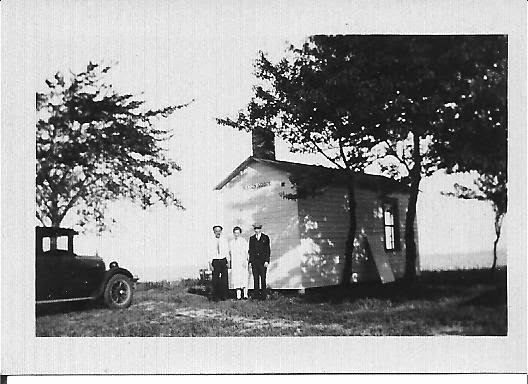
Remember...

Ancestral energy lives in the stars above us, the stones beneath us. Their memory gathers in oceans, rivers and seas. It hums its silent wisdom within the body of every tree.

Wednesday, July 30, 2014

My Great Aunts and Uncles

Libby Dutcher, the artist at work.
In my quest for uncovering as many names as I can for our family tree, I applied a focused tunnel-vision to my search. Who is my grandfather? Who were his parents, and their parents, and their parents? I mostly neglect the names of other children who were not my direct ancestors, noting (sometimes) how many children they had total, and maybe a list of names if it’s an easy copy and paste.
Recently, I had a sobering realization that, not having children, I will become that name on someone else’s family tree that I ignore. There will not be anyone who searches for me. I will forever be someone else’s Great Aunt, however many times removed.
Some of my zeal in uncovering our family history is in getting to share it with my nieces and nephew. It’s in anticipating sharing it with my great aunts and uncles as I grow older. In honor of the acknowledgement that I have dismissed some members from my family tree who may have had very fascinating lives themselves, and in gratitude to my father, who didn’t, I want to share the lives of two of my kin, my Great-Aunt Mary Elizabeth Dutcher and my Great-Uncle Frank Wicker.

Great-Aunt Libby
The cottage, prepared for Swami in 1895.
My 3x Great-Aunt Libby was sister to Reuben Feagles Dutcher, my 3x Great-Grandfather. Mary Elizabeth Dutcher, known as Libby, was a respected artist in her lifetime. I have held a couple of her small board paintings in my hands. I have had my eyes on a beautiful watercolor of the Islands themselves. As far as my research shows, she never married. She never had any children.
But she did own a Victorian cottage on the St. Lawrence River, in the 1,000 Islands. The Thousand Island Park was 20 years old when she lived there, built as a place to encourage the exchange of ideas in an atmosphere of relaxation and meditation, attracting speakers like Susan B. Anthony and Frederick Douglas. There were 600 cottages in the community on June 18, 1895, when Swami Vivekananda arrived at the Park.
In 1893, he traveled from India to the World Parliament of Religions in Chicago, uninvited, encouraged by his fellow monks to represent Hinduism at the event. A Harvard professor asked him to address the crowd and he opened with this prayer: "As different streams, having their sources in different places, all mingle their water in the sea; so, O Lord, the different paths which men take through different tendencies, various though they appear, crooked or straight, all lead to Thee."
His address is credited with changing the tone of the gathering itself. After the Parliament, he traveled for two years on a strenuous lecture tour. What does Swami Vivekananda have to do with my Great-Aunt? During this tour, my Great-Aunt Libby attended his spiritual classes in New York City and invited him to retreat at her cottage in the Islands.
Libby at the cottage.
In preparation for his arrival, she added a wing to her cottage for his initial seven-week stay, coming at the end of a strenuous to years of lecturing. This wing was actually a three-story addition, comprised of a guest room, a classroom, and a private room for Swami, a monk and follower of Sri Ramakrishna. He was 32 years old.
While visiting Libby’s cottage, Swami taught his followers and began compiling his writings. He eventually returned to India. Swami died at the age of 39 but his work served as inspiration for Rabindranath Tagore, Mahatma Gandhi, Ravi Shankar, and, decades later, George Harrison.
The cottage today.
Today, Libby Dutcher’s cottage still stands, bearing the name of Swami Vivekananda. It is a sanctuary and place of pilgrimage for his followers. The cottage itself, beautifully restored, is open to the public for tours during the summer months. Dirt from holy places in India was buried on the land. Water from the Ganges was poured into the St. Lawrence. The room that Libby built as Swami’s living space is a chapel now.
I love knowing that the place where she built her home, where she created an environment of art and thoughtful expression, is now a sacred site. I may not know a lot about her, but being able to learn about someone who inspired her so deeply, allows me to build a connection to her ghost.

Great Uncle Frank

Frank (L), William, and Hiram (R).
My 2x Great-Uncle Frank Newell Wicker was one of three brothers to my 2x Great-Grandfather Hiram King Wicker. The Wickers moved to Lockport, NY in about 1845, but once the Civil War started, Frank’s career kept him in perpetual motion. He enlisted in the 28th Regiment of N.Y. Volunteers in 1861.
His previous position with the Lockport Home Guards earned him a promotion to lieutenant. During his service, he earned a reputation for daring, courage, and a cool head in battle. At some point, a Confederate Force was tasked to capture him, but all their attempts failed. He was promoted to the Signal Corps where he served as an officer for the remainder of the war, seeing battle at Antietam and Georgetown.
Frank was discharged in 1865, but stayed in government service for the rest of his life. In August that year he was second in command of 1,000 men for the Russian-American Telegraph Expedition. He kept a diary of the three months it took to reach their destination (which I am currently transcribing). The men were tasked with laying telegraph line through British Columbia and Alaska, and laying cable across the Bering Straits, through Siberia (eventually scrapped by the construction of the transatlantic cable).
While in Alaska, Frank acted as a surveyor and wrote many documents for the U.S. government about the wealth of the land he saw, including reports on the Alaska seal fisheries. It was my Uncle Frank’s final recommendation that convinced the United States to buy Alaska. In 1869, Frank was assigned there as Special Agent of the Treasury.
Wicker’s next job was as collector of customs at Key West, Florida. He was appointed by President Grant in 1873. Due to a Cuban civil war against Spain, Key West was full of refugees. In 1884, he was dismissed from his position without notice.
Uncle Frank's handwriting.
According to a Cuban newspaper from 1912: “A monster meeting was held at San Carlos hall, patriotic speeches were made, and the audience requested to subscribe funds to aid [Cuban patriot] Aguerro to fit out another expedition. The first to respond was Colonel Frank N. Wicker, the collector of customs at this port; he contributed one hundred dollars. The Spanish consul telegraphed this to Washington and Colonel Wicker was removed from office. Colonel Wicker was probably actuated by a desire to serve his political party. He was the leader of the Republicans in Key West, and knew that this act of friendship to the Cuban cause would be remembered by the impulsive patriotic Cubans, and that they would help his party when he should call on them for support. His name should go down in history as the first American martyr to the cause of Cuban liberty, as well as a martyr to his party.”
He was next, quickly, given an assignment as appraiser at the Port of New Orleans, where he was at the time of his death, in February 1903, of heart disease. He was a member of eight different secret orders during his lifetime, including the Knights Templar and the Mystic Shrine, something his and his siblings had in common. His brother, my 2x Great-Grandpa Hiram, was a Past Eminent Commander of the Masons of New York.

It's about connection. It's about growth. It's about how we are all relations. It's about living. And it's about love. In the words of the spiritual teacher of my 3x Great-Aunt Libby:

Wednesday, July 23, 2014

On the Beach in Olcott

Hattie Eva Dutcher, married Smith, 1857-1882
Last year, my father showed me two recent family acquisitions, paintings on wood done by my Great-Great-Grandma Hattie Eva Dutcher, born in 1857. She later lived in Olcott NY, a small hamlet on the shore of Lake Ontario, where my Great-Grandma was born. The small wood board paintings were both of the shoreline at Olcott.
Between 1870 and 1877, two piers, extending out into the water 1800 feet, were built at Olcott, with a small lighthouse going up on the West pier. This village harbor held the deepest point of entry for boats. My 2x Great-Grandma would have watched the small town grow, poised for boom. At this time, before the 1900s, getting to Olcott, a popular vacation retreat, meant taking a horse and buggy.
I’ve learned that Hattie Dutcher’s aunt, Miss Mary Elizabeth ‘Libby’ Dutcher, was a well-known and respected artist, who lived in the 1000 Islands. It’s not surprising that her niece would try her hand at the craft. The paintings I held, in my childhood home, were beautiful, full of color and wonder. I shouldn’t have been surprised- artistic talent, whether singing, painting, or carpentry, has been a through-line in uncovering my family genealogy.
My 2x Great-Grandma Hattie died when she was 25, a month after giving birth to my Great-Grandma, her daughter and namesake. She died of anemia, complications from childbirth.
I wasn’t aware in my childhood, when we spent our summers in Olcott, that my family had so much history there. I wasn’t aware that multiple members of my family, on both sides, had lived and summered there. For me, it was a place to play and swim, to walk out on the broken concrete piers with my hand carefully tucked into my mom or dad’s hand.
There was always plenty of green grass to play in. The air was full of the sound of surf and gulls. My lungs were filled with the smells of sand and seaweed. And oh, the glorious sunsets at dusk!
I sat at the water’s edge on a recent trip, meditating to the sound of the waves, slowing my breath to match their rhythm. I drifted backwards into my bloodstream, feeling the effects of time on the landscape around me. I thought backwards to those who had walked the sands beneath me…
My father and I talking on the porch of his one-room cottage, before sunset.
The photo I have of my Grandpa Mark (in the dark suit on the right) standing in front of his family cottage on the bluff, with his parents Royal Eaton and Hattie Eva Smith.
The photo of my Grandma Ruth (right) and my Great-Grandma Hattie Eva (back to the camera) laughing on the beach with my Great-Aunt Dorothy (far left).
The paintings my Great-Great-Grandma Hattie captured of the lake. I wonder if she ever sat where I sat. I wonder what the beaches looked like at the close of the civil war, when she might have sat with her small wooden boards and her paints and brushes.

It amazed me to hold something that she held, to see the beach through her eyes, through the way her hand skillfully translated the view she beheld. I wonder how old she was when she painted it. I wonder how young.
Where I sat on the beach, I imagined myself sitting with her, her long skirts tucked in around her legs. Did she dig her toes into the sand like I do? Did she collect rocks, too? Did she immerse herself in nature like me?

We gazed at the sunset together, a girl and a ghost, a granddaughter and a grandmother. A daughter and a mother. As the sun set, the water turned white and the clouds turned blue, and the echoes and ripples of our family danced out with the tide.

Wednesday, July 16, 2014

Viking Origins: Lineage

The Vikings invade, from the Bayeux Tapestry.
Open disclaimer: This information is based on accepted lineage for royal lines. I do not claim that these lines are 100% accurate but, as most amateur genealogists, I am working under the assumption that they are, until I prove that they are not. I am not a true historian, I am just trying to research my family lines.
It should also be noted that no one agrees on the accuracy of lineages this old. There are differing birth and death dates between written accounts. There are so many variations of name spellings that exactly who the documents were really referring to is a source of speculation. So take every with a grain of salt. This is the best of what is currently believed to be true. It’s a possible/likely truth, not an indisputable one.
Rollo Ragnvaldsson was born in 846 in Maer, Norway. He died having been made Duke of Normandy in 932, in Rouen, Normandy. Both my parents descend from him, from two separate children, following a long trail down to re-converge in me.

Rollo to Riddle
34x) Rollo Rognvaldsson, with Poppa de Valois (taken after a raid)
33x) dau. Adaele ‘Gerloc’ de Normandie, married Duke Guillaume III of Aquitaine
32x) dau. Adelaide de Poitou, married King Hugh Capet
31x) son King Robert of Orleans II, married Constance de Toulouse
30x) son Henri I of France, married Anna Agnesa Yaroslavna, Duchess of Kiev
29x) son King Phillippe I of France, married Countess Bertha of Holland
28x) son King Louis VI of France, married Countess Alix Marie of Savoie
27x) son King Louis VII of France, married Constance of Castile
26x) dau. Alys, Countess of the Vexin, married Count William IV of Pontieu
25x) dau. Countess Marie de Ponthieu, married Count Simon II de Dammartin
24x) dau. Jeanne de Dammartin, married King Fernando II of Castile & Leon
23x) dau. Princess Leonor of Castile & Leon, married King Edward I, Longshanks
22x) dau. Princess Elizabeth of Rhuddlan, married Humphrey de Bohun VIII
21x) son William de Bohun, married Elizabeth de Badlesmere
20x) dau. Elizabeth de Bohun, married Richard FitzAlan III
19x) dau. Elizabeth FitzAlan, married Sir Robert Gousell
18x) dau. Elizabeth Gousell, married Robert Wingfield
17x) son Sir John Wingfield, married Elizabeth FitzLewis
16x) son Sir John Wingfield II, married Margaret Dorward
15x) son Thomas Wingfield, married Elizabeth Woodhouse
14x) dau. Elizabeth Wingfield, married Geoffrey Downing
13x) son George Downing, married Dorcas Blois
12x) son Sir George Downing, married Miss Bellamy
11x) dau. Abigail Downing, married John Goode [travelled from ENG to MA]
10x) dau Abigail Goode, married Robert Moulton
9x) son Robert Moulton II, married Mary Cooke [in Salem during Witch Trials]
8x) son Robert Moulton III, married Hannah Groves [in Salem during Witch Trials]
7x) son Freeborn Moulton, married Rebekah Walker
6x) dau. Rebekah Moulton, married Thomas Ridel, of Ireland
5x) son Joseph Riddle, married Mary or Polly
4x) son Freeborn-Moulton Riddle, married Abigail Chaffe
3x) son Marquis DeLafayette Riddle, married Sarah Clickner
2x) son Lafayette Riddle, married Frances Ann Gillette
1x) son Harold Lafayette Riddle, married Elsie Elizabeth Durant
Their son Richard James Riddle was my grandfather. On my mother’s side, I am descended from Rollo through 15 daughters and 20 sons.

Rollo to Eaton
40x) Rollo Rognvaldsson, with Poppa de Valois (taken in a raid)
39x) son William I, Duke of Normandy, with Adele Sprota de Bretagne (a concubine)
38x) son Richard I, Duke of Normandy, married Gunnera de Crepon of Denmark
37x) son Richard II, Duke of Normandy, married Judith de Bretagne
36x) son Robert VI, Duke of Normandy, married Herleva ‘Artelle’ de Falaise
35x) dau. Adelaide de Normandie, married Count Lambert of Boulougne
34x) son Waltheof II, Earl of Northumbria, married Judith of Lens
33x) dau. Mathilda de Northumbria, married Simon de Senlis/Saint Liz
32x) dau Maud de Senlis, married Lord Saher de Quincey
31x) son Sir Robert de Quincey, married Orabella de Leuchars
30x) son Earl Saher de Quincey, married Margaret de Beaumont
29x) dau. Loretta de Quincey, married William de Valognes
28x) dau. Sibilia de Valognes, married Robert de Stuteville IV
27x) dau. Helwise de Stuteville, married William de Lancaster
26x) son Henry de Lea, married unknown
25x) son John de Lea, married Hawise de Lancaster [his aunt/her nephew]
24x) son Henry de Lea, married unknown
23x) son William de Lea, married Clemence de Banastre
22x) dau. Sibilia de Lea, married Sir Richard de Houghton
21x) dau. Sybil de Houghton, married Robert de Clitheroe
20x) son Hugh de Clitheroe, married Isabel de Gras
19x) dau. Mary Clitheroe, married John Tempest
18x) dau. Elizabeth Tempest, married Sir Richard Norton
17x) dau. Margaret Norton, married Sir John de Stapleton
16x) dau. Christina Stapleton, married Robert Cressett
15x) son Thomas Cressett, married Jane Joan Corbet
14x) son Richard Cressett, married Joan Wrottesley
13x) dau. Jane Cressett, married Sir Henry Eaton
12x) son William Eaton, married Martha Jenkins
11x) son William Eaton II, Minister, married Jane Hussey
10x) son Nicholas Eaton, married Katherine Masters
9x) son John Eaton, married Abigail Gilson [travelled ENG to MA, 1635]
8x) son John Eaton, married Alice
7x) son Thomas Eaton, married Lydia Gay
6x) son Thomas Eaton, married Elizabeth Parker
5x) son Benjamin Eaton, married Hepsibah Skiff
4x) son Joshua Eaton, married Lucy Gould
3x) son Solomon Gould Eaton, married Hannah Ann Treadwell
2x) son Bennett Eaton, married Theresa Cordelia Tenney
1x) son Royal Levant Eaton, married Hattie Eva Smith
Their son Mark Dutcher Eaton was my grandfather. On my father’s side I am descended from Rollo through 13 daughters and 28 sons.


Are we cousins? Are any of these names familiar to you? Do you have differing information? Do we share ancestors in common? Shoot me an e-mail and let me know. I love meeting my very distant relations!

Wednesday, July 9, 2014

Viking Origins: Rollo Ragnsvaldsson

Open disclaimer: This information is based on accepted lineage for royal lines. I do not claim that these lines are 100% accurate but, as most amateur genealogists, I am working under the assumption that they are, until I prove that they are not. I am not a true historian, I am just trying to research my family lines. Especially in documenting old lineages, all history seems to be in dispute.
I previously wrote how I discovered that my mother and father shared a common ancestor in Henry II, King of England. Last year, I found that they have another ancestor in common, further back, in Rollo Ragnsvaldsson, the first Duke of Normandy (or Count- I’ll only say once that historians are actively arguing about whether there even were duchys and dukedoms yet). His name is also seen as Rognsvaldsson, with the ‘a’ and ‘o’ being interchangeable. I use both. Rollo Ragnvaldsson is my 34x Great-Grandfather on my mother’s side and my 40x Great-Grandfather on my father’s side.
Rollo Ragnvaldsson was the son of
Ragnvald I Eysteinsson, the son of
Eystein Glumra Ivarsson, the son of
Ivar Halfdansson, the son of
Halfdan Sveidsson, the son of
Sveide Sviadrasson, the son of
Svidri Heytsson, the son of
Heytir Gorrasson, my 41/47x Great-Grandfather.
Rollo ‘Rolf’ Ragnvaldsson was also known as Hrolfr the Ganger/Walker. He was born in Maer, Nord-Trondelag in northern Norway, about 846 C.E. Rollo was the son of Ragnvald Eysteinsson, the Earl/Jarl of More, and Ragnhild Hilder Hrolfsdottir, daughter of Hrolf Nefia. The family’s insignia was a wolf’s head. The Orkneyinga saga mentions: “Earl Rognvald joined Harold fair-hair when he seized the land, but he (Harold) gave him lordship over both the Maeren and Romsdale; he had to wife Ragnhilda the daughter of Hrolf nosy; their son was Hrolf who won Normandy, he was so tall that horses could not carry him; for that he was called Ganging-Hrolf; from him are come the Rouen Jarls and the English Kings…”
There is a tale that King Harald vowed to leave his hair untrimmed until all of Norway was under his rule. Ten years later, he gave Earl Ragnvald the honor of cutting his hair and trimming up his beard. It is said that Harald’s sons took offense to the honor and burned Ragnvald, and many of his men, within his own home. The title Earl of More was passed on to Rollo’s brother Thori. The details cannot be verified, but it is known that Ragnvald died in his home, in a house fire.
Around 876, Rollo fell on the wrong side of King Harald ‘Fairhair’ Harfagre. Another folktale says he took advantage of the favor shown them by their King and took some cattle from Harald’s conquered lands. Whatever the true slight, he was banished from Norway to the Hebrides, where he found other men who did not wish to swear fealty to a King and they joined together in raiding Flanders before turning to France.
Rollo was a lesser leader in a Viking fleet of 700 ships that besieged Paris under Sigfred, who was given tribute to retreat from the city and leave it in peace. Rollo did not leave with Sigfred. Like others, he stayed behind and took raiding jobs for hire. He participated in the Viking raid on Bayeux. At the defeat and death of Berenger de Bayeaux, Rollo took his daughter Poppa de Valois of Normandy, approximately nineteen years old at the time, as his consort, though there is no record of an official marriage. Poppa’s grandfather was Pepin, Count of Peronne, the great-grandson of Charlemagne.
Legend says that unlike other Vikings, at this point, exiled from his home, Rollo Ragnsvaldsson was more interested in land he could settle on than plunder. I could not find history that agreed on a true timeline of events. That the following raids occurred is not in doubt.
Around the spring of 896, he participated in a raid on Rouen. The people watched as low ships with serpent heads and reptile tails filled the Seine. An Archbishop went to the Northman camp, alone, and received safe passage and fair treatment. Rollo/Rolf agreed to spare the people and their belongings if they turned their city over to him. He made Rouen his base camp and became known for his friendliness with the people: “Wherever he met with resistance, he showed, indeed, the relentless cruelty of the heathen pirate; but where he found submission, he was a kind master, and these qualities contributed to gain for him an easy and rapid conquest of Neustria, as the district of which Rouen was the capital was then called.”
Once he held Rouen, Rollo joined Vikings on another raid of Paris. They camped outside the fortified city for thirteen months, hoping to starve the people out. They eventually gave up without instigating battle and left Paris for the lands of Burgundy. Around 900 C.E. his son William I Longsword (my ancestor) was born. His other children with Poppa de Valois during this time period were Gerloc de Normandie who was baptized as Adela (my ancestor), Robert of Corbeil, Crespina de Normandie, Gerletta de Normandie, and Kathlin de Normandie.
In 911, Rollo was created the 1st Duc de Normandie in the treaty of Saint-Clair-sur-Epte, by King Charles the Simple of France. On the condition that he would be baptized in the Christian faith and defend the Seine River against other invading forces, Rollo Ragnvaldsson was granted Rouen and lands around it. This land would be known in our histories as Normandy.
Legend says that when Rollo was bid to pay fealty to the King, and kiss his foot, he refused. He had one of his men do it in his stead, but all Northmen were proud. It is said that the man, rather than stooping down to kiss the foot, instead grabbed it and raised it to his lips, upending the King to his comrades’ delight. One tale did say the King was on horseback, and was almost upset, but claim it was not as disastrous an affair as it might have been. Either way, some stories say the Franks ignored the insult, and others say Rollo smoothed things over by apologizing for his country’s odd customs or bad manners.
The Northmen who created the origins of Normandy adopted the manners and behaviors of the nobles of England and France, even if they did not abandon all of their own ways. Rollo was baptized and given the Frankish name of Robert. Any man who was baptized in Rollo’s party was gifted with lands of his own. Rollo/Robert married Gisela, daughter of Charles the Simple. She was four years old at the time. It is historically agreed that they did not care at all for each other and she died childless.
In 922, Charles the Simple was deposed from the throne by Robert I. Rollo considered his oath to the King fulfilled with Charles’ death. He began a westward expansion into Le Mans, Bayeux, Bessinin, and Picardy. There are many differing stories about Rollo’s exploits as a master, but they all agree that he created an era of peace on his own lands. Whether it was a pile of gold or simply a priceless gold bracelet, tales tell that Rollo had precious goods left out in the public eye, and they were never stolen. One reason no one dared steal it was because none of his people had a need to. His serfs considered him a friend of the people. Another reason was that the punishment for doing so would be swift and final.
Rollo turned his Dukedom over to his son William/Guillaume I Longsword a year before his death. The historian Adhemar writes that at the end of his life, Rollo went mad. He ordered the beheading of one-hundred Christian prisoners, in order to honor the gods he had worshipped. In repentance for the act, he gifted various churches one-hundred pounds of gold to honor the “true god in whose name he had accepted baptism.” Historians agree that he may have embraced Christianity, but he never fully dismissed his pagan beliefs.

The Duke of Normandy, Rollo Ragnvaldsson, died and was entombed at Rouen, Caux, France. The epitaph on his tomb reads: In the temple’s womb rests Rollo/ Father and the first Duke of Normandy, devastated and founded by him/ Out of strength from this labour he died 933, aged over 80 years. His descendants, including William the Conqueror, were also Dukes of Normandy. Following the Norman conquest of England in 1066, they became Norman Kings of England as well.

Wednesday, July 2, 2014

A Gift from Mother Crane

Part of my ancestor work involves being present in the world now. I honor and remember my ancestors. Someday I will be a part of that ancestral energy. I know this. I think about how I want those who come after will think about how we left the world for them. And I try to spread joy and peace and kindness. I try to make that who I am in the world today.
We spend our lives trying to find ourselves, trying to find our place, trying to find a way to be of use. Or we spend our lives just trying to survive. We are each a strand on the larger web, and there are crossroads where our paths converge. It is when we open ourselves to these moments that we build layers to the web. We become the web. We see our interconnectedness. We see and we are seen.
This past weekend I attended the New York Faerie Festival in Ouaquaga, NY, a place of play where Renaissance Faire meets Fae and other world beings like goblins, dryads, mermaids, trolls, fauns, elves, unicorns, dragons, and fairies- both local and visiting- are interspersed with human travelers. All meet in a sprawling wood along a creek. It’s a place thick with magic, whatever that means to you.
One of my favorite encounters over the weekend was with Mother Crane, her arms laden with brightly-colored papers as she walked around, engaging passersby. I found her reading a poem for another guest and waited my turn. When it came, she looked at me a moment, then down to her papers. With a quick nod of her head she plucked one out.
It was perfect. It encapsulated the sweetness of what summer means to me. Taking a breath in, Mother Crane looked me in the eye and began to read the words of Wendell Berry:

The cherries turn ripe, ripe,
and the birds come: red-headed
and red-bellied woodpeckers,
blue jays, cedar waxwings,
robins—beautiful, hungry, wild
in our domestic tree. I pick
with the birds, gathering the red
cherries alight among the dark
leaves, my hands so sticky
with juice the fruit will hardly
drop from them into the pail.
The birds pick as I pick, all
of us delighted in the weighty heights
--the fruit red ripe, the green leaves,
the blue sky and white clouds,
all tending to flight—making
the most of this sweetness against
the time when there will be none.


Enjoy the summer. Enjoy the sun. Take in the brightness. Remember the light in the darkness. Become the light. Be a beacon of light during darker times. May that light birth joy. May the world be a brighter place because you were part of it. May we all walk towards peace and togetherness.

Wednesday, June 25, 2014

Elsie Elizabeth Durant Riddle

My great-grandparents at Niagara Falls.
My Great-Grandma Elsie was a summer solstice baby. She was born on June 21, 1904. She died January 9, 1994, my senior year of high school. This past solstice, as I stood in a dark wood surrounded by thick clouds of fireflies beneath a star-lit sky, I sang Happy Birthday to her. The memory of Elsie was strong with me- the cool feel of her skin, the sound of her laugh, and the crooked way her smile would lift up on one side before stretching across her face.
I realized she would have been 110 years old. There was something to that moment, as if it made missing her less painful, knowing that she likely would have expired naturally by now. There are no more lost years we could have had together, like the ones her disease robbed us of before she died. I still miss her, but I hold her close.
Her smile and laugh lit up the room. Her love filled my heart with warmth like the sun in the sky. She was special and I cannot celebrate summer without thinking about her. I was born nine months after my Great-Grandpa Harold Riddle died of a heart attack and the day I came into the world would have been their fifty-second wedding anniversary.
I don’t know anyone who didn’t love her. When I started high school, one of the band teachers, Mr. Allison, sought me out just to tell me how much she meant to him. During his formative years, she watched him, and he seemed to love her as much as I did. In that moment, my world shifted. I understood how one person can ripple through people’s lives without realizing it. Elsie was special. She was a pip.
Meeting her for the first time.
All of my childhood, my Grandma-from-Florida (that’s where they retired to so that’s what I called her) would come and live with us for the summer months. Every time I bite into a ripe sun-warmed strawberry, the sweetness I take in reminds me of those shared memories. There was a room in our small house that had been the upstairs bathroom. When the bathroom was moved downstairs, they left the toilet upstairs, a smart choice for a house with small children. This extra room was where she slept, right next to my bedroom. I used to sit on the edge of her bed while she dressed in the morning, slipping on her hose and open-toed cork sandals, to go with her culottes and the sweater she would throw over her shoulders.
Her touch was always cool and soothing in the summer heat. She tried to explain to me how it was much hotter where she lived, so she was cold during the summer. My small world couldn’t comprehend anything hotter than 100 degree heat.
            My Grandma Elsie was one of my first pen pals, encouraging me with my writing. When I got glasses in third grade, I was nervous because only a couple other kids in my class had them, and they were picked on. She wrote me about how absolutely no one had them when she was in school except for her, and it would be okay. She always said I could ask her anything.
Us again, 8th grade for me.
Every Christmas at my grandparents’ house, we would pass the phone around to talk to her, long before I was old enough to use the phone myself. I remember the wonder I had at her voice on the phone, sounding so close to me, as if I had expected the miles between us to manifest through the receiver. Science is magic to the mind of a child.
She was a practicing Catholic and she believed in it. I sing Ave Maria to her all the time. I know that somewhere, wherever she is, she hears it. In the years after, through my genealogical work, I discovered more about her than I knew in life.
Her parents were George Francis Durant and Emma Louise Burnah who were married in 1889. He was sixteen and she was twenty. The Durants were French-Canadian; both of George’s parents had emigrated from Quebec. The surname Burnah has been hard to place and has been found in a variety of forms such as Burnah, Burneh, Burmah, Bruneh, Brunet, and Burnett. I can follow the Durants, LaRoches, and Lavallees into Quebec and France. The Burnahs remain a mystery I dream of solving for Elsie. I want to know her mother. I want to know where her mother came from.
Her father George was a laborer, living in both New York and Vermont for work. George and Emma had seven living children, of which Elsie was the youngest. I remember her telling me that she was the baby, and she teased us that the baby was never spoiled- followed by her impish laughter. Elsie’s family lived in Burlington, Vermont before landing in Lockport, New York, a town along the Erie Canal.
She married Harold Riddle in 1924 at the age of 20. He was 21, the son of a farmer, and he worked as a chauffeur, driving motor truck and later working as a die setter at the local Radiator factory. They had three children together: Harold Jr. who was called “Sonny,” my grandpa Richard, and their daughter Donna.
Sonny was a bit of trouble through most of his life and I know he caused my great-grandma heartache. I only knew him as birthday cards, sent faithfully every year, singed “Love, Uncle Sonny.” He spent his early years in prison outside San Luis Obispo for bank robbery and was in a wheelchair for the rest of his life. He lost his legs to gangrene due to infections from his time on the run.
Great-grandma Elsie and my Grandpa Dick would often talk about Sonny as a young boy, telling censored stories from his childhood. But there was a truth to the quiet way his name was spoken, and the absence of him in family stories and the family time that included us children. I am old enough now to know how it feels to have things sit so painfully in you that you cannot bear it words. I know how you can love someone so deeply, even though their choices are hurtful to others, and you cannot condone the actions they take.
For a time, to make ends meet, my great-grandparents moved to Somerset where they owned a small convenient store and worked a farm for food while renting out their home in Lockport. While they lived there, my Poppa Harold lived part-time with family in Lockport, working at Harrison Radiator. Later, for a time, they shared a duplex with my mother and her parents, having their own space on one side. They retired to St. Petersburg, Florida, which is where my Poppa passed away.
Before he died, my Grandpa told me that his parents loved each other very much and that Harold doted on Elsie. His father was easy-going unless one of the children sassed their mother or talked back to her and then he would rise like a bear to her defense. I remember hearing her say, “You grandfather and I…” to my mom around the kitchen table. My brother remembered him. I knew all I needed to know from the way she spoke about him, the way her tone revealed how little her love for him had faded. I remember feeling wistfully like I had missed out on knowing a great man.
I discovered on the census reports that Elsie’s parents lived with them for most of her marriage, until they died. My mom said she declared that she would never live with her children. She didn’t think it was fair. And she never did.
There was one year she didn’t stay with us. She stayed with my Grandparents instead. My mom explained that she was ill and they wanted a quieter space for her. I heard the whispered stories during the summer of her forgetting where she was, who my Grandpa was, of her getting up at 3 a.m. in a panic, pulling her sweater on backwards over her nightgown, because she had to get lunch ready for the children. That was the year I learned the word Alzheimers.
She stayed in Florida after that and was moved into a nursing home. My great-Aunt Donna lived nearby. My mom and grandpa went down multiple times to visit her, but we never saw her again. Her mind descended quickly. She died on in 1994 after complications from a hip surgery she got from falling. She was 89 years old.

I have one recipe from her, for Swiss Steak. It was written in the early 1960s on an index card with a birdhouse decorating it. My dad said she used to make this all the time, and it was his favorite dish. I copied it out, exactly as she wrote it, line for line.

[side 1]
Round steak
cut in serving size pieces
sprinkle both sides with flour
pound flour in steak with
rolling pin or heavy utensil
brown on both sides in hot fat
I use oil.  place in small
roaster or cake pan.  Slice a
couple onions place in pan
salt +/ pepper meat + onions.
pour over tomatoe juice, or regularly canned
tomatoes, or a can of tomato soup (over)
[side 2]
delute with ½ can of water if you
use the soup.  Bake in oven
350 degrees about 1 hr 15 min.
or until Tender.  Turn meat
over when about half done.
can be cooked in electric
fry pan.  But has to be
watched so it doesn’t burn or
stick.

Wednesday, June 18, 2014

Perspective, or If the World Were 100 People

In 1994, the world population was at 5,606,000,000 people. In 2004, it rose to 6,387,000,000 people. It’s 2014 and the world population is now 7,141,000,000. It’s only going to keep rising. It’s a scary thought, knowing our resources are finite. But that’s another post for another time. This post is about perspective.
We’re at a cultural crossroads and we have two choices. Either we decide that there are too many people in the world and we care only about ourselves and we could give a crap about our neighbors. On that path we take what we need, whether or not we’re taking from someone else. Or we understand that there are so many people in the world, we are not and cannot be more important than another. On that path we understand that we should be working towards making sure what we have is shared as equally as possible.
We should be taking care of each other. It’s hard to do when money is the bottom line and big business seems to have more legal protections than people do. How can we fight that? What is required is perspective on a smaller scale. It’s really hard to imagine 7.1 billion people, and harder still to care about that many people when, in our lives, we juggle maintaining relationships with and caring for less than a hundred people.
But what if the world was only 100 people? There is a list of statistics that has been going around since 1990, and is often updated. Unsurprisingly, the numbers in it change constantly. For instance, in 1990 only 1 out of 100 people had a college education. In fourteen years, that number has risen to 7. I found this to be an interesting exercise in where I fall in the larger, yet more simplified, statistical world.
Disclaimer: The actual statistics may vary slightly from what I have. I tried to find the most current numbers for each category but they are not all from the same year. For my purposes, this post is about creating perspective, not accuracy.

If the world were a village of 100 people…
  • There are 50 women and 50 men.
  • There are 66 adults aged 15-64, 26 children 14 and under, and 8 adults 65 and older.
  • Only 30 are white; 70 are not.
  • 89 people are heterosexual; 11 are homosexual.
  • The continental breakdown is: 60 people live in Asia, 15 in Africa, 11 in Europe, 9 in South America and the Caribbean, and 5 in North America.
  • 12 people speak Chinese, 5 Spanish, 5 English, 3 Arabic, 3 Hindi, 3 Bengali, 3 Portuguese, 2 Russian, 2 Japanese. 62 people, more than half of our village, speak other languages than these.
  • 33 people are Christian, 22 are Muslim, 14 are Hindu, 7 Buddhism; 5 people find their spirituality in nature; 7 people practice other religions and 12 more do not align themselves with a religion.
  • 48 people can’t speak or act on their faith because of fear of harassment, imprisonment, torture, or death; 52 people can.
  • 77 people have shelter from the elements; 23 do not.
  • 51 people live in urban areas; 49 people live in rural ones.
  • 63 people are adequately nourished, or better; 21 people are overweight, 15 people are undernourished and 1 person is dying of starvation.
  • 87 people have access to safe drinking water; 13 do not.
  • 68 people breathe clean air; 32 people do not.
  • 48 people live on less than $2 US dollars a day.
  • 12 of our 26 children live in poverty.
  • 30 people are unemployed.
  • 9 people are disabled.
  • 78 people have electricity; 22 do not.
  • 65 people have improved sanitation conditions; 19 people have unimproved toilets (which basically means they at least have a poo pit somewhere away from the room they live in); 16 people do not have toilets.
  • 83 people can read and write; 17 cannot.
  • 7 people have a college degree; (93 people do not, less 26 children means…) 67 adults without one.
  • 22 people share or own a computer while 78 people do not have access to their own computer.
  • Only 30 people are active internet users.
  • 75 out of 100 people are cell phone users.
  • 40 people have no shoes.
  • Less than 1% of people have HIV/AIDS.
  • 6 people own 59% of the wealth.

Out of 100 people:
I am one of the 50 women in the village and one of the 30 white people. I am one of the 66 adults under the age of sixty-five. I am one of 11 queer folk. I am one of the 5 people from North America and one of the 5 people, out of 100, who speak English. I am one of 5 people who find my spirituality in nature, and am one of 52 people who can practice my faith freely.
I am one of 77 people who have shelter I rent and one of 78 people with electricity. I am one of 51 people living in an urban area, though it blends its edges with the rural farms that feed us. I am one of 21 overweight people and technically one of the 48 people living on less than $2 a day. I am one of the 30 unemployed. I am one of 87 people with access to safe drinking water, one of 68 people breathing clean air, and one of 65 with a flush toilet in my bathroom.
I am one of the 83 people who can read and write and one of 7 people who got a college degree. I am one of 22 people with a computer and one of the 30 active internet users. I am one of the 60 people who owns shoes (I have four pairs), and, I am one of the 25 people who do not own a cell phone.

I am unique. I am one of a kind, among many who are one of a kind. I am special, but not more than another. May we all find our way to peace, tolerance, and coexistence.


Creative Commons License
This work is licensed under a Creative Commons Attribution-NonCommercial-NoDerivs 3.0 Unported License.