Remember...

Ancestral energy lives in the stars above us, the stones beneath us. Their memory gathers in oceans, rivers and seas. It hums its silent wisdom within the body of every tree.

Wednesday, August 3, 2011

The Spaces In-Between

At the height of summer the land around us is dense and thick with green leaves, blossoms, and ripening fruits and vegetables. Multiple scents swirl through the air vying for dominance as their pheromones call out to the animal world, which is active and in motion around us whether we choose to take notice of it or not. This season becomes a cycle of long hot days followed by brief cool nights. But even as the length of day changes, the constant remains that in-between night and day comes dawn and between day and night comes dusk.
In my spirituality I do a lot of work that some would call dark, concerning edgewalking, shadow work and shapeshifting. It involves exploring energetic boundaries and manipulating them, reshaping them as well as walking between worlds. It is dark work, in the sense that magic is both light and dark and I embrace both sides of it, not just the ones that feel safe. In order to do this kind of otherworld work you have to believe 100%- not 99.9%- that it’s possible. It requires faith and an acceptance in more than what you can see.
The labyrinth is a good metaphor for how I seem my work. You go inward, into the unknown and into the darkness to learn what lies at the center, at the core. And then you return from the darkness into the light, filled with the wisdom, illuminated. You have to go inward before you can go outward. What happens in between in and out? What happens at the center? This is where the magic lies.
In the physical labyrinth, we walk the spaces between the walls. To walk the labyrinth is to find yourself in-between. To shift edges, you find the space that lies between cells and expand or shrink it. To do healing, you find the space between the edge of the trauma and the edge of the healthy tissue/organ/thought. To reach trance you find the silence between the drum beats and you dive into it. You peer into it and you push.
My spirituality is how I worked towards changing the way I thought about myself and the world. First I had to dismember all of the reasons I felt I was not a good person and heal my core. You have to walk into the darkness to do this work. Then once I could stand firmly in my body, I looked at how the world was, how I related to it and then how it related to me.
Like Malidoma Patrice Somé, a spiritual teacher of the Dagara people of Africa, I had to unlearn the structure of my Western teachings in order to expand the way my brain was able to see the world. I would say that my work is about facing my fears as a means of healing to become a more solid version of myself, so that I may guide others on their paths of growth and evolution.

One of the tools I use to accomplish this work is a trance which can be done at dawn or dusk, at the in-between times of the day. These periods are of the transition, the shifting of light into darkness and occur during the point of grey haze of mid-time. This happens when the landscape seems to lose the intensity of color and everything begins to fuzz and blur. This is the magic time that connects the sun and moon, the day and night. As light and shadow can shift, something we can see, so can and does energy, though it is something we can’t see.
I do this gloaming trance as a means of connecting more deeply to nature, specifically the land around me. In the beginning, like with anything you don’t know how to do, it was more an exercise in sitting still and not letting the buzzing bugs pull me from meditation than it was in exploration. I could have given up when I decided it wasn’t working for me, but I thought of the Buddhist monks and the Catholic Nuns and their repetitive devotion and I pressed onward. Four years later, I can slip easily into and out of that space.
You have to practice anything you want to be good at.
I find a place at an edge of water, of woods, of fire. Somewhere visible the landscape changes. As the daylight fades (I prefer dusk trance), I let my eyes soften their focus until I can see everything, but no one thing is clear. And then I find another in-between space, like the shadow between two distant tree trunks. I find that shadow and I peer into it, deepening it. And then I follow the journey to where it takes me, not allowing anything to pull my focus from the exploration.
I came to myself from trance, this last holiday, under a dark moon in a field surrounded by woods and water. I felt myself become more part of the forest until I was no longer me, the human, visiting the trees. Rather, I became a creature of the woods. My energetic body stretched like roots and all at once I could feel the breeze brush against bark and the skitter of small critter paws scurrying across earth. Everything was glowing slightly luminescent.
When I began the trance, I was a woman sitting in a field. When I returned I was a human animal living on the earth with glowing fireflies, mosquito-eating bats, bat-evading gnats, hooting barred owls, fluttering dragonflies and damselflies, beautiful red-spotted purple butterflies, persistent hickory tussock moth caterpillars, the croaking frogs and cheeping peepers.
In that small space of land we have seen the large murder of crows that roost nearby dive-bombing hunters shooting at them, beavers building dams, scuttling skunks scavenging, baby raccoons kitten-walking into the elder bush, coy dogs hunting, catfish swimming, hummingbirds feeding and a great blue heron nesting and fishing. Every time I trance I am reminded of the surety of my humble place in this world. Each time it is a more comfortable truth.
I listened to the sounds of the crows conversing and calling and laughing as they roosted at dusk and roused their brethren at dawn. I listened to the sounds of the world waking and sleeping and waited for the moment between, as the crow cawed. I slipped in, knowing I would come out renewed.


Relevant Posts:
Malidoma Patrice Somé: Supernatural and Science (posted July 20, 2011)

Wednesday, July 27, 2011

Our Ancient Ancestors


We’re nearing harvest time in the Northeast. I have already plucked handfuls of green and purple beans from our small garden and am readying for the plump green tomatoes that will ripen red and yellow soon. The land is rich and verdant with life at this time of year and the whispering voices of my ancestors find me more easily as centuries of lives overlay across each other in a shared body memory of readying for harvest.
Knowing so much of my genealogy has been a blessing for which I am grateful. I understand now that even if I was not gifted the ability to trace my line back through documented lives, I would feel the tug and pull in my blood back to a time when man lived off the land, before houses, before settling in a fixed spot. I would feel it as surely as a body cannot help but feel the pull of the tide as the water carries it out to sea.
There are many times in my adult days that I have felt an internal emotion of being lost or feeling adrift. A buoy lost in the ocean. It’s the gravity that opened my mind up to wanting to know my place in the world and motivated me to find my place in the world by quieting myself and discovering what was happening in the world around me, right now.
            It has often made me wonder what it would feel like to not be able to trace any of my ancestry. What if I was adopted? What if there simply weren’t any names or clues? In some of my research into the lesser-known side of my family tree I discovered that another descendant of one of my ancestors, one more directly descended, participated in a DNA research program produced by National Geographic that traced Captain Samuel Walker’s genetic ancestry.
            According to the Genographic Project, descendants of Samuel Walker belong to a specific genetic Haplogroup based on a Y-chromosome test. The Haplogroup is I2b1 (M223+). According to other information they have acquired, this specific Haplogroup originated in northern France 14,000 to 18,000 years ago and is found most commonly within Viking and/or Scandanavian populations in northwest Europe.
            This Haplogroup could be further separated into three subclades. For example, I21b1a (M284+) originated specifically in the Bristish Isles, between 3,120 and 3,700 years ago. Unfortunately, Samuel Walker tested negatively against the three known subclades so any further tailoring won’t occur without more samples, though the known information posits that the line is of Viking origin.

            What does that mean? Per the test results, if this were my direct line, I would know that the M223+ strain was a genetic mutation that occurred in a single man living in what we now know as southern France. As the glaciers retreated north, so did the animal herds and so did the hunters with this strain. Their descendants founded the Gravettian culture known for their voluptuous Venus figurines. Which would give me a visual group of humans to reach backwards into history to connect to.

The National Geographic Genographic Project
The National Geographic Society began the Genographic Project in 2005 with the purpose of working collaboratively with different indigenous groups around the globe to collect DNA samples with the intention of learning more depth as to where we came from in our evolutionary migrations. This project allowed the Society to open it up to the general public as well, as a means of supporting the Genographic Legacy Fund.
The Public Participation Kits are expensive at $99 per kit, but are completely inclusive and cover the cost of processing the lab results and the proceeds go towards the Legacy Fund to help indigenous people revitalize their cultures. It is “directed primarily toward education initiatives, cultural conservation, and linguistic preservation and revitalization efforts” per the project director, Dr. Spencer Wells.
There are two separate kits, for two separate tests. If you are a woman you can only take the mitochondrial DNA test which traces your direct maternal ancestry. Men can take the mitochondrial DNA test or the Y-chromosome test, which traces your direct paternal ancestry. If you are a woman, and you have a close relative in your paternal line, like a father or brother, you can swab their DNA and get results that would be accurate for you as well.
It’s not going to tell you who you’re related to or who your ancestors were. It is going to tell you where your DNA links to groups and where they were and when they were there, like a general migration story back into history, with a professional portfolio detailing al of the information for you. And your results are constantly updated with more information as more samples are collected. The project samples are being collected until the end of 2011, but the Public Participation Kits will be available long-term, with the purpose of collecting more data and continuing to finance the Legacy Fund.

If you are someone who has no information with which to seek out personal ancestry, and it feels important to you to have a picture of your bloodline to help you tap into those energies, the Genographic Project might be a worthy investment to give yourself some tangible information to meditate with. The mysteries of our past live in our blood and are no longer so far out of reach.

Link: For more information, visit the National Geographic Genographic Project page...

Wednesday, July 20, 2011

Malidoma Patrice Somé: Supernatural and Science

Malidoma Patrice Somé is a remarkable man, straddling two worlds and successfully acting as a mediator and translator between them both. He was born to the Dagara people of Burkina Faso in West Africa. Malidoma was kidnapped from his village at the age of four by a Jesuit Missionary who had befriended his father. He was placed in a boarding school, on path to become a priest, to be used as a tool to convert the African people to the white man’s God.
When he was twenty he managed to run away and walked the entire length of the distance back to his village, where he found himself home, but a stranger among strangers. He had been gone for fifteen years and could not even recall enough of the Dagara language to communicate with his mother and sister.
His Western world upbringing left him inadequately prepared for his return. He and his people did not understand each other. Well past the age of manhood in his village, Malidoma was required to undergo a month-long rite of passage before he could fully become a member of his community.
He had to first unlearn what he had learned.

His trials are compellingly written in his book Of Water and the Spirit: Ritual, Magic, and Initiation in the Life of an African Shaman. In the book he describes one of his first breakthroughs, where he was bid to sit and watch a tree. He was aware of his own head processing through wondering what the purpose was, of wondering what the correct thing to do was. There had to be more to it than staring at a tree, right? Then he became angry and felt like he was being made to go through a public humiliation, being sat in the center of the village. Then he broke open and began to speak to the tree. It became a sort of confessional where he poured his feelings of frustration out and apologized to the tree.
What he experienced next was a transformation of the tree into what he calls the green lady- a green human form spirit who felt like love and home. He ran sobbing to the spirit and she held him in her arms. When he came out of the moment and was hugging the tree he immediately tried to blame the vision on the heat and lack of food- which is the Western way of thought- except that the elders of his tribe who were watching had seen the same green lady when he did. How could he explain that?  

“My experience with the green lady raises an important
issue, namely, the true identity of the elements of nature.
What if they are not inanimate objects, as people in the
West have been taught to believe, but rather living
presences? How would we need to change if we granted
to a tree the kind of life that we usually reserve for so-
called intelligent beings? If you peek long enough into
the natural world - the trees, the hills, the rivers, and all
natural things - you start to realize that their spirit is
much bigger than what can be seen, that the visible part
of nature is only a small portion of what nature is.”

            What we would call the supernatural, his people call the natural world. They have no word for supernatural. The closest word they have is Yielbongura, “the thing that knowledge can’t eat.” Western thought may have decided that it is separate but that doesn’t make it a truth for the larger world.
In fact, that way of thinking will only serve to separate us more from that which we all want most- to rediscover the sensation of wholeness. Spirit is real. What is spiritual can be explained by science, but not explained away. After all, you can put blinders on a horse so that he cannot see the distractions around him, but the distractions around him are still occurring. He does not see, yet they happen.
That’s true of the fullness of the world around us. Either you are open to it or you are closed to it, but it does not stop existing if we do not believe in it. If we choose to, we can do work to open ourselves up to the spirit world, the larger world, the greater web around us. We can see and hear with more senses than we use. People who have had these experiences, as Malidoma had, often decide in the aftermath that they must have hallucinated. So much of the spirit world is ephemeral that it takes a certain amount of faith and openness to make the connection.

"You can acquire what is usually seen as magical. When in
fact the more you dwell in this kind of world, the less you
see it as magical because it is the familiar, it is the kind of
thing that every human being is entitled to and it is the kind
of thing that is at the core of human nature, the search,
the intense search for the magical." 

            I can’t recommend Somé’s writings enough. He has two other books The Healing Wisdom of Africa, which chronicles his life after the awakening, and Ritual: Power, Healing and Community. The story of his life’s journey and the purpose his Ancestors gifted him with is laced and woven with a breathtaking, wondrous, and seemingly simplistic awareness of the larger world that stretches beyond our everyday perception. Malidoma’s words act as a gateway, a doorway that the reader can grasp, an opening they can step through.

Wednesday, July 13, 2011

Spirit World: Ghost Visitations


Why can you see ghosts and I can’t?

It’s a question I get asked, mostly by people who ache to see a deceased loved one. Technically, I don’t see ghosts, at least not like movies, such as The Sixth Sense, would have you believe. Sometimes I see them, sometimes I hear them, sometimes it’s the hairs on my body standing on end that alert me to the presence of something Other. It’s not something I can control at will. I can’t call my Grandpa up and ask him to come visit. I think the more we ache and want a thing, the more we are blind to it.
Opening to other worlds is an intuitive knowledge. It demands a relaxing of self and a separation from want or need. The more open you are to the impossible and the more in touch you are with your intuitive body, the closer your connection to the spirit world can be. Seeing spirits doesn’t come hand in hand with the ancestor work that I do, but if a person dedicates themselves to connecting with the spirit world, interaction with other beings is inevitable.
The worlds overlap, the physical world and the ones of ether. Sometimes there is a cross over, where humans can hear whispers from another world. Sometimes the space we are in will shift slightly sideways as the echo of a past world blinks in for a moment.
Reality is fluid, like time, and currents shift and change at random intervals. Overlapping worlds do the same. Sometimes the streams merge. I have sensations of rooms being crowded when they’re not. I now trust that to mean there are spirits about. That doesn’t mean the spirit acknowledges or takes notice of my presence. We’re just sharing the same space for a moment.
When the spiritual presence is strong enough, I can see apparitions like a flickering image from an old movie. But mostly I see them out of the corner of my eye, a human form, and when I turn around there is a blur of vapor- like when you look at the wavering air over the top of a bonfire. Only, at the same time in my head, I get moments of flesh tone and hair shape and color. Clothing silhouette and notion details. It will fill out like flashes of photographs… but at the same time, it’s all at once and immediate and whole.
It’s okay if that doesn’t make sense. Sometimes I barely comprehend it myself. I just trust that what I’m experiencing is happening. Truthfully, I saw more ghosts when I was little than I do now. Kids often lose their wonder around age 8, because there are societal rules to follow and ways of fitting into this world that we are taught. Everything else falls away in the learning of this adult framework. And the grown-up world tells little children that magic is not real. And we close ourselves off to it.

I’m learning to reopen those doors. If you want to learn about the spirit world I experience from movies, try watching The Others instead of the processed haunted house fare. In my experience, it’s an accurate example of what the overlapping worlds are like.
Dawn and dusk are powerful times to do Otherworld magic. In the same vein of thought, we are susceptible to openness in the first moments drifting into and coming out of sleep. One morning, senior year of high school, I woke up in my pale pink bedroom and opened my eyes to see my Great-Grandmother Elsie sitting at the end of my bed. She was wearing a pale blue housedress with a sweater on over it.
“Good morning. You know I love you.”
Love you, too, Grandma, I said in my sleep, mumbling it nonchalantly before the notion of speaking to her woke me.
When I sat up, I assumed I’d been dreaming. She wasn’t really there, she was in Florida. She had just had surgery on a broken hip she’d gotten from falling in her nursing home. I had forgotten about the exchange until a few hours later when my Grandpa’s car pulled up in front of the house. And then I remembered the morning visitation. And I knew. With every fiber of muscle and bone of my being, I knew what had happened. I slipped up to my bedroom before he got out of his car.
My Grandpa came over every Saturday at noon on the dot to visit. I’d tease him if he was a minute late (once I learned how to tell time). And he’d tease me back, wondering what I was having for lunch that day with an impish twinkle (I ate the same thing for years- a bologna, cheese, mustard and potato chip sandwich). But the day his car pulled up in front of the house was Sunday, not Saturday.
When my mom came upstairs to tell me, all I could do was say that I knew. Elsie had died from complications of her surgery. She was 89 and had been suffering from Alzheimers in her last years. I had been torturing myself for months over the prospect of not being able to see her again.
History and legend are littered with stories of people seeing deceased loved ones moments before discovering they died. I imagine it’s like a last exhalation of intention. If I take no other consolation from the apparition at the end of my bed, in that moment of visitation, when she looked at me, she knew me. It doesn’t have to mean more than goodbye.

Wednesday, July 6, 2011

Healing in Dreams

I have a very active dream life. In fact, I always have, and can still recall dreams I had as a child. For six years I have been logging my dreams every morning. I had to learn to relax my mind before the subconscious swept in and pushed the night musings back into dreaming. It is still hard to ignore that first song of the morning that runs through the back of my brain and it is never easy to ignore the day’s checklist, popping up before my eyelids open.

Everything gets easier with practice. Dreams help our brains process and filter all the invisible things we perceive throughout the day. Some people may never have nightmares. Some people may never remember their dreams. Maybe that’s for the best, because constantly remembering your dreams can feel like living with feet in two different worlds but you have to make the most with what you have. What I discovered is that I can do a lot of healing in my dream world.

Shamans do a lot of travel and healing via the dream world and it’s their wisdom I have used for my own work. After opening a doorway to heal myself, my dreamings deepened and became patterns of usefulness. And then a back door opened, into another world, allowing spirits access to me. The only conversations I’ve ever held with ghosts have been in my dreams. The ghost beings always seem a bit out of place, a bit superimposed on top of the events happening, as if they’re slightly out of frame. And they are often just as amazed at what they’re looking at as I am. It’s a bit of a tell.

I believe in spirit. I believe in the spirit world. I believe in spirits and ghosts. It’s hard to believe in something you’ve never experienced. That takes great faith. So I don’t expect people to believe ghosts are real purely on my say so. But I’m going to believe it, because I’ve experienced it.

As a child I had five imaginary friends but my first one, who I called Amy, was a ghost (you’ll hear more about her later). She was my only imaginary friend whose clothes I couldn’t change. She walked barefoot beside me through the snow in the wintertime. I remember that her name was something like Amalthea or Amalia… maybe even Amelia, but it all sounded foreign to the five year-old me who suffered a speech impediment. So I called her Amy.

Amy was one of the first spirits who made an appearance in a dream of mine to catch my attention. It’s common enough now. Some spirits were unknown to me, but being able to recognize them helped me track them down; a friend’s classmate and a loved one’s Great-Grandfather. I just accept it. (If you allow dream elements to surprise you into awareness that is what will pull you out of the work and the remembering.)

A Dog Called Leather
This past weekend I had a dream in which I was taking our family pet, Leather, for a walk. She was a smart and sassy blonde cocker spaniel who died in 2008. The dream itself was simple. My hair was hanging loose and long like it is now and I was wearing my brown crocs. Leather and I were walking down the block and she was stiff and slow but willing. I was worried that I was pushing her but the longer we walked the more energy she seemed to have. Her coat was shiny again and as we got to the end of the street she was bouncing around a yard with a small Chihuahua. They were excitedly sniffing each other’s butts.

I started to cross the street and turned around but she was laying down. I called her to me and she finally got up to come but paused halfway across the road and sat down in the middle of traffic, exhausted. I ran out to get her as a truck swerved past and took her home. My mom wanted to see her to make sure she was all right. She was laying on a blanket in the living room. In my dream the living room was in the front of the house, which hasn’t been the living room since my childhood. And the blanket she was laying on was one I used to use to make a mountain for my Barbie dolls to climb. I hold Leather’s muzzle in my hands and tell her what a good girl she was. Was. The word catches in my throat. My mom is worried that Leather looks tired…

I woke up not knowing for a moment why dreaming of Leather should make me sad. And then I recalled the feeling of her jaw in my hand and her hair on my flesh and if I close my eyes, right now, I can still feel her against my skin. At the end of the dream, I understand that my brain was reliving the moment Luna passed. But it was more than that, too.

The dream gifted me a new memory with a very dear friend.

Wednesday, June 29, 2011

Ancestral Migrations

2011-1820: New York, United States
My mother is the last Riddle in our line, according to how the Western world understands genealogy. The truth is that the blood will continue to travel down in the lives of my nieces and nephew, and their children, and their children. Just because the name will fall out of use on our tongues doesn’t erase the blood.

It always comes back to the blood. Over a century, Riddles moved westward from the Massachusetts coast into the unsettled lands of Western New York. They were soldiers and farmers and family men.

1820-1759: Massachusetts, America
In America, we can trace the Riddles back to Thomas Ridel who married Rebekah Moulton in Monson, MA in 1759. He emigrated from Tyrone County, Ireland. Beyond that, there is no documentation as to who his parents were or when he actually came to America (barring a trip to Ireland to hope to root through old documents). I could have assumed this was the end of the trail, which it is, if the names of my ancestors are the only goal I am concerned with.

It’s just as important to me to know where my people came from, where they travelled, what they struggled through. I ran a search for the “history of Riddles in Tyrone County Ireland.” In the 1700s, many Presbyterian Scots were pushed to move out of the country, resulting in five great migrations of Scots-Irish to the New World. I assume one of the first four migrations were when Thomas came over:
  • 1717-1718 (drought)
  • 1725-1729 (poverty)
  • 1740-1741 (famine)
  • 1754-1755 (disastrous drought)
  • 1771-1775 (poverty)

1759-1687: Tyrone Co., Ireland
The Riddles who settled in Tyrone Co. did so during a time in Europe when William and Mary, Protestants, were fighting the Catholic King James to keep England from falling back under Catholic rule after he gave birth to a legitimate Catholic heir. Protestant landowners began seeking out others willing to move to Northern Ireland and push out the Catholics there. The Riddles settled in Ulster and Tyrone Co. and for just over a century, taking on the description of Scots-Irish.


1687-1100: Lothian, Scottish Lowlands
The people of the lowlands were not Scottish, nor were they English. They did not wear kilts, speak Gaelic and they didn’t live in clans. They were descended of Viking blood, the children of Normans who interbred with Scottish families.

They were Northmen who became Lowlanders, existing in between political and geographical countries in lands that were difficult to farm and subjected to multiple cattle raids that eventually left them no option but to attempt the same. The Ridels were among the first Normans to hold estates in Scotland.

In 1125, Walter Ridel received the oldest charter gifted from a King to a layman, in the lands originally called Lilliesleaf. They were called by the name Riddell in the 1400s. Because of this original charter, Riddell became a denotation of lands held by families not of Scottish heritage (i.e. Cranston Riddell and Glen-riddell).

Walter Ridel was thought to be a brother or nephew of Gervasius/Gervase/Geoffrey Ridel, both of whom travelled to Scotland with David I, Prince and Duke of Cumberland. They were both favored friends of the court. Gervase was appointed High Sheriff of Roxburghshire in 1116. The Ridels lived in the lowlands for generations.

1100-1066: England
Where did they come from, if they weren’t Scottish or English? Thanks to historians, I found an answer. The Sieur de Riddel, and his brothers, accompanied William the Conqueror in the Battle of Hastings and was a man of importance to William, who appointed him Lord-Chief-Justice of England. They were Norman invaders, come to conquer the island. Gervase was granted lands there, perishing at sea in 1120 on return trip to France. His sons stayed on in England.


1066-940: Normandy, France: Land of the Northmen
In 910, the Viking Jarl, Thorfinn Rollo the Ganger, invaded France. Rollo is considered to be the first great Norman invader (and is an unverified paternal ancestor of mine). The Vikings were explorers who began their raids in search of food. When they discovered the fertile lands of France, some of the Scandanavians decided to stay. My ancestors were among these men.

940-unknown: Rugdale or Ryedale, Scandanavia
The Ridels were Scandanavians who are believed to have originated in Rugdal or Ryedale, known as the Valley of Rye. It was thought that the spelling changed in the pronunciation of Rye-dale on the Scottish tongue. Another theory is that the meaning of the name never lost its original meaning.

A riddle was a tool, or instrument, used to clean and winnow rye and other grains. The surname Ridler or Riddler denoted one who winnowed grain.

Variants of the surname are: RIDEL, RIDDELL, RIDDLE, RIDDEL, RIDALL, RIDDEL, RIDDAL, RIDAL, RIDALE, RIDDELLE, RIDDELS, RIDDLETON, RIDDLEY, RIDELEIGH, RIDLAND, RIDLE, RIDLER, RIDLEY, RIDLON, RILLY, RUDDELL, RUDDLE, RUGDAL, RYDDLAND, RYDLEY, RYEDALE

Ancestral Migrations
How many other families would find themselves traced back to the same Scandanavian people? The lesson in this for me is that we cannot afford to define ourselves by who we are- all those labels and boxes- because we all were the same people at some point in time. Remember that the next time you are walking about your city, and look around at your human kin.

Wednesday, June 22, 2011

Strawberry Jam

I remember being little in my mother’s kitchen in the summertime while she made jam. It was hot out and hotter in the small room painted with a 60’s orange and yellow gloss. But the house smelled sweetly of strawberries. The bright red berry is the perfect metaphor for the season. Fruit that takes so sweet and so good and whose time passes too quickly, and then is gone again. It’s fitting that it blooms only for the longest days of the year, and then fades into a memory of what freshly ripened strawberry tastes like.

It’s a blessing that store-bought jelly was new to me (It’s also amusing that in my college days I stood in the grocery store not sure what the difference between “jam” and “jelly” was). I loved the shelves of canned goods gathering dust from where they sat in the basement workshop. Our dirt and gravel basement was a liminal space in my childhood, still part of the house but also part of the earth beneath us. It was the place my father built things and the space that held our pantry, and the way the centipedes and mice got into our home.

As a child, when asked to retrieve tomato sauce, applesauce, or jam from the basement, I was always caught between terror at creeping down where the centipedes lived, where the 10’ to the shelves momentarily became a vast expanse, and the gratitude for the temporary reprieve from the heat. It was always cool down there, where the centipedes lived, in the basement that smelled of gravel dust and wood.

I work at deepening my connection to the natural world with my practice. Every year I make plans for the things I want to do that are not currently part of my normal life- like gardening and canning. While most of my relationship with the natural world has taught me to slow down, when it comes to growing your own food you have to be patient, yes, but you have to be prepared for your own burst of energy and dedication when the crops are ready for harvest,

Summer is a busy time for me and each year, it has long passed before I have realized my window to make fresh jam has also passed. It’s a common excuse I find myself saying when I don’t get around to doing things by hand, that I was too busy and time got away from me. If I were a nomadic caveman and I wanted to eat, finding food would be a priority. The fast pace world we live in is no excuse for not taking care of basic needs.

It might be more convenient to buy jam in the grocery store but that jam would have been picked by my hand, chosen by my hand, cleaned and hulled in my kitchen and then cooked on my stove. I know the ancestry of my jam, from the farmer I met who planted the seeds and nurtured the plants, to my hands, to the bellies of my family and friends. How great a gift is that?


Picking
I carved out a two-day window for strawberry picking at a local farm, amused with the thunderstorms that poured down before and after, and the black cloud that sat above us during. Thanks for the shade, Mother Nature. It was overcast and wet, but clear as we drove in.

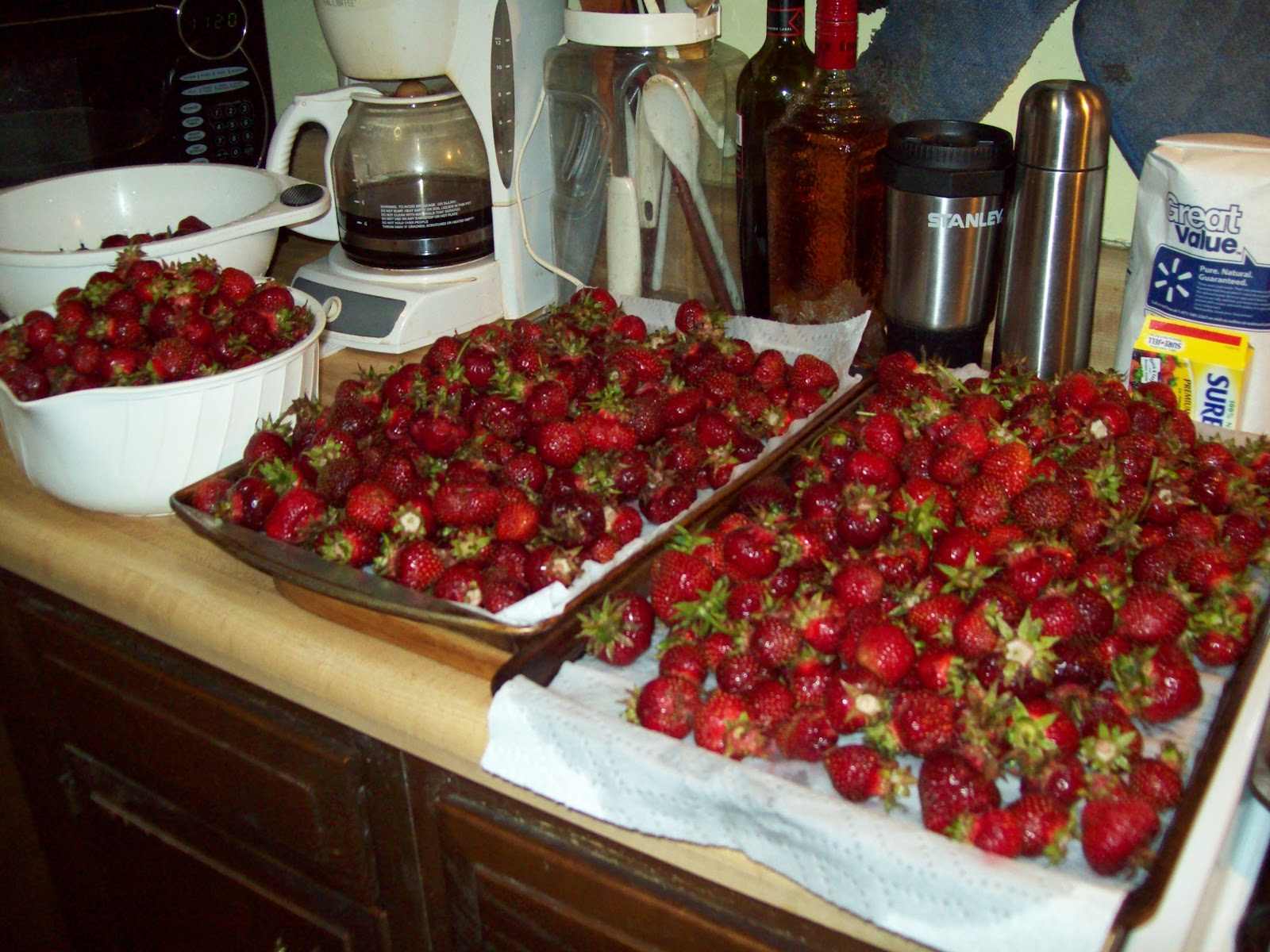
Crows lifted out of the field in a small cloud of feather and air, dangling plump red strawberries from their beaks as they flew for the tree line and the river just beyond. The rows of berries were brilliant with crimson color as far down the row as you could see. I barely had to move, there were so many, which allowed me to be more selective. Lifting up stalks of fruit, it was easy to pull them off the stem with a gratifying and crisp snap. We made quick work and came home with much more than the 2 quarts I needed for jam.

Jamming
I hulled and mashed what I needed for the recipe and barely made a dent in the berries I had cleaned. It was easy to take another half-hour and hull a bunch of strawberries to be frozen, so that if the jam came out well, I could make another batch later this summer with our fresh/frozen berries.
I have never made jam before, and it might bear mentioning that I am not the most competent cook, but I am learning. Being in the kitchen is like being in a foreign land where everyone speaks a language I have no translation for: “quart” and “blanche” and “rapid boil,” etc. It seems unnatural that I struggle so hard to learn to provide my body with nourishment, which is why it has become a large part of my ancestor work. I used the recipe on the Pectin box and followed it exactly.

You know what, mom? You were right. Making jam was far easier than I anticipated. Jars and bands were washed and waited in a steam bath in the sink so they would still be hot when I needed them. Actually cooking the jam only took 20 minutes. The aroma wafting through the house was delicious, like the best quality of a hot sticky summer day. I used a water-canner I scored at a thrift store and 10 minutes later, pulled out the jars to hear them sealing with a metallic ping.

After only an hour and a half of cooking, I have enough jam to get my family through six months. Another batch of jam made with the strawberries I froze means we can have enough homemade jam to last us until next summer, when the strawberries will be ripe again. And I will be waiting. Waiting to make jam again.
Creative Commons License
This work is licensed under a Creative Commons Attribution-NonCommercial-NoDerivs 3.0 Unported License.