Remember...

Ancestral energy lives in the stars above us, the stones beneath us. Their memory gathers in oceans, rivers and seas. It hums its silent wisdom within the body of every tree.

Showing posts with label canning. Show all posts

Wednesday, October 9, 2013

Canning Autumn Applesauce

At Russell Farms, 2013.
Autumn is my favorite time of year to live in the Northeast. Even though I have always lived in the Northeast, I don’t take the changing of seasons for granted. Red, yellow, and orange leaves crunching underfoot, and apple cider. We are lucky to have multiple apple orchards around us like Russell Farms, Lone Maple Farm, Apple Hills Farm, and Torto’s.
Autumn belongs to the apples: Gala, Honeycrisp, Gingergold, Golden Delicious, Macintosh, Macoun, Empire, Pink Lady, Granny Smith… Through the winter, spring, and summer months, I forget what apple tastes like until I pluck one from the tree and bite my teeth into that firm and crisp flesh for the first time. I eat fresh apples daily when they’re in season, because I know it won’t last. Spiritually, I am growing an appreciation for impermanence. It makes you appreciate things when you have them more. After all, our very lives are an exercise in impermanence.
Even so, it is nice to be able to carry a bit of this season into the ones that will come after. When the apples are their ripest, I make and can applesauce to get me through till next harvest. My mother canned. My grandmother canned. I don’t do it as much as I’d like to. I do it because I know that when I open a jar this February, autumn’s harvest flavor will be there. That taste of the first bite of a ripe apple will flood my mouth. No chemicals. No preservatives. No added sugar. Just apples, and a small stick of cinnamon.

I find the prep work is the hardest. You have to wash all the jars in warm soapy water. Fill them with hot water and place them in the canning pot. Add enough water so it sits above the jars by an inch. Cover the pot and bring it towards a boil over medium-high heat. When it is almost boiling, reduce hit to a simmer. Keep it covered until you use the jars. [This part took me an hour.]
Then, in a small saucepan, pour two inches of water in the bottom. Add the lids and heat on low until it reaches a simmer. Cover the saucepan and take it off the heat. Set it aside until you’re ready to use them. Now, you’re ready to make the applesauce, which is fairly easy.

I had a small retinue of apples for this batch. Normally, I might add a splash of water for every four apples I use, but I have found that fresh apples rarely require extra moisture. I peel, core, and cut the apples into slices. Everyone does it different, I’ve found. No matter how you cut them, it’s important to keep the pieces of even size. Add as many cinnamon sticks as you desire to taste- a dash of ginger is always a nice complement, if you want a little tang.
Place everything in a saucepan, cover, and heat on medium for fifteen to twenty minutes. Use a fork to see how easily the tines pass through the fruit. If it passes through without resistance, you’re done. Turn the heat off, remove the cinnamon sticks and mash away. I have a potato masher that I use because I like to make chunky applesauce, but for smooth applesauce I whisk it after it’s been mashed. Now, you’re ready to can!

Remove the jars from the canning pot, carefully, and empty them of their water. I dry them out with a clean cloth. Fill the jars with applesauce, leaving a half-inch of headspace. When the jars are full, gently shake the jars back and forth to release air pockets. You can also slide a clean knife around the edge of the jar to help release them. Wipe the rims with a clean cloth. Use tongs to pull a lid out of the saucepan and set it on the jar. Screw a band in until it’s just tightened.
When they’re all done, place the jars back in the canner (beware of hot water). Make sure, again, that there is at least an inch of water covering the jars. Cover the pot and bring the water to a boil. When the water starts boiling, process the jars for fifteen minutes. Turn off the heat and remove the lid. Let the pot stand for about five minutes. Remove jars onto a clean towel on a table or counter. My canning pot has a basket that I can rise to lift the cans above the water line. But before I found my canner at the thrift store (for five dollars), I used a large stock pot and heavy-grade canning tongs.

Give the jars twelve to twenty-four hours to cool, depending on their size. You may hear a strange warpy, metallic, pinging sound. That’s good. You want to hear that sound. It means the seals are locking and the canning worked. Don’t fret if you don’t hear it either, though. That’s happened to me. When the jars are cooled, press lightly on the seal. If it doesn’t give, it worked, and you can safely store them for up to a year, just in time for the new crop! If the seal gives beneath your finger, it didn’t take. That just means you can pop them in the fridge and eat them right away. 

Wednesday, June 22, 2011

Strawberry Jam

I remember being little in my mother’s kitchen in the summertime while she made jam. It was hot out and hotter in the small room painted with a 60’s orange and yellow gloss. But the house smelled sweetly of strawberries. The bright red berry is the perfect metaphor for the season. Fruit that takes so sweet and so good and whose time passes too quickly, and then is gone again. It’s fitting that it blooms only for the longest days of the year, and then fades into a memory of what freshly ripened strawberry tastes like.

It’s a blessing that store-bought jelly was new to me (It’s also amusing that in my college days I stood in the grocery store not sure what the difference between “jam” and “jelly” was). I loved the shelves of canned goods gathering dust from where they sat in the basement workshop. Our dirt and gravel basement was a liminal space in my childhood, still part of the house but also part of the earth beneath us. It was the place my father built things and the space that held our pantry, and the way the centipedes and mice got into our home.

As a child, when asked to retrieve tomato sauce, applesauce, or jam from the basement, I was always caught between terror at creeping down where the centipedes lived, where the 10’ to the shelves momentarily became a vast expanse, and the gratitude for the temporary reprieve from the heat. It was always cool down there, where the centipedes lived, in the basement that smelled of gravel dust and wood.

I work at deepening my connection to the natural world with my practice. Every year I make plans for the things I want to do that are not currently part of my normal life- like gardening and canning. While most of my relationship with the natural world has taught me to slow down, when it comes to growing your own food you have to be patient, yes, but you have to be prepared for your own burst of energy and dedication when the crops are ready for harvest,

Summer is a busy time for me and each year, it has long passed before I have realized my window to make fresh jam has also passed. It’s a common excuse I find myself saying when I don’t get around to doing things by hand, that I was too busy and time got away from me. If I were a nomadic caveman and I wanted to eat, finding food would be a priority. The fast pace world we live in is no excuse for not taking care of basic needs.

It might be more convenient to buy jam in the grocery store but that jam would have been picked by my hand, chosen by my hand, cleaned and hulled in my kitchen and then cooked on my stove. I know the ancestry of my jam, from the farmer I met who planted the seeds and nurtured the plants, to my hands, to the bellies of my family and friends. How great a gift is that?


Picking
I carved out a two-day window for strawberry picking at a local farm, amused with the thunderstorms that poured down before and after, and the black cloud that sat above us during. Thanks for the shade, Mother Nature. It was overcast and wet, but clear as we drove in.

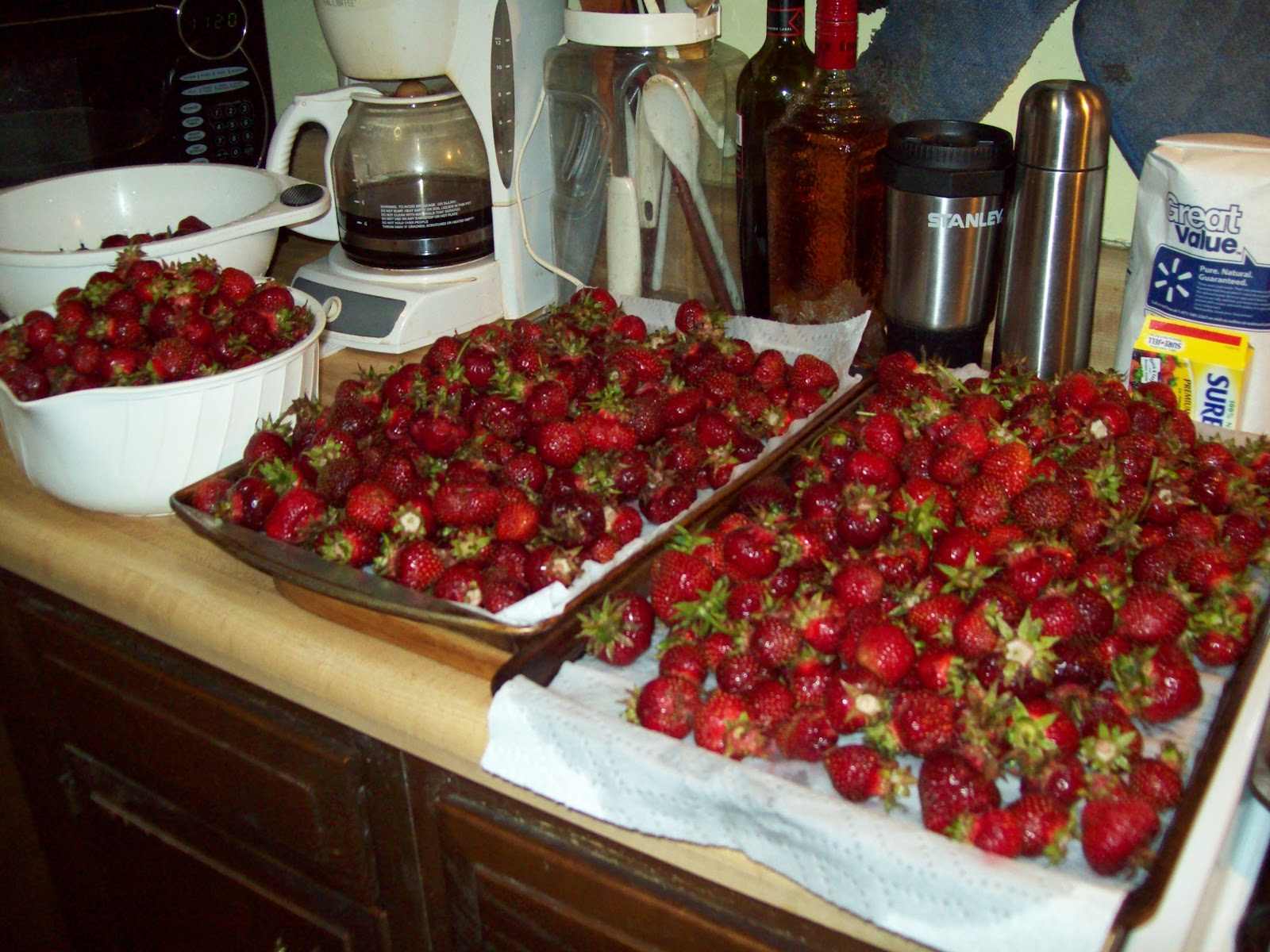
Crows lifted out of the field in a small cloud of feather and air, dangling plump red strawberries from their beaks as they flew for the tree line and the river just beyond. The rows of berries were brilliant with crimson color as far down the row as you could see. I barely had to move, there were so many, which allowed me to be more selective. Lifting up stalks of fruit, it was easy to pull them off the stem with a gratifying and crisp snap. We made quick work and came home with much more than the 2 quarts I needed for jam.

Jamming
I hulled and mashed what I needed for the recipe and barely made a dent in the berries I had cleaned. It was easy to take another half-hour and hull a bunch of strawberries to be frozen, so that if the jam came out well, I could make another batch later this summer with our fresh/frozen berries.
I have never made jam before, and it might bear mentioning that I am not the most competent cook, but I am learning. Being in the kitchen is like being in a foreign land where everyone speaks a language I have no translation for: “quart” and “blanche” and “rapid boil,” etc. It seems unnatural that I struggle so hard to learn to provide my body with nourishment, which is why it has become a large part of my ancestor work. I used the recipe on the Pectin box and followed it exactly.

You know what, mom? You were right. Making jam was far easier than I anticipated. Jars and bands were washed and waited in a steam bath in the sink so they would still be hot when I needed them. Actually cooking the jam only took 20 minutes. The aroma wafting through the house was delicious, like the best quality of a hot sticky summer day. I used a water-canner I scored at a thrift store and 10 minutes later, pulled out the jars to hear them sealing with a metallic ping.

After only an hour and a half of cooking, I have enough jam to get my family through six months. Another batch of jam made with the strawberries I froze means we can have enough homemade jam to last us until next summer, when the strawberries will be ripe again. And I will be waiting. Waiting to make jam again.
Creative Commons License
This work is licensed under a Creative Commons Attribution-NonCommercial-NoDerivs 3.0 Unported License.